
The short answer. Customers should not have to manage your business to get what they bought. When a request crosses departments, one person should own the answer, explain what happens next and say when it will arrive.
A customer should not have to manage your business to get what they bought. The awkward part is that every department can be doing its job while nobody owns the answer.
Imagine a customer trying to move a delivery from Tuesday to Thursday. She has already paid. She has the order number, the confirmation email and a perfectly ordinary request. What she does not have is an afternoon to become familiar with your organisation.
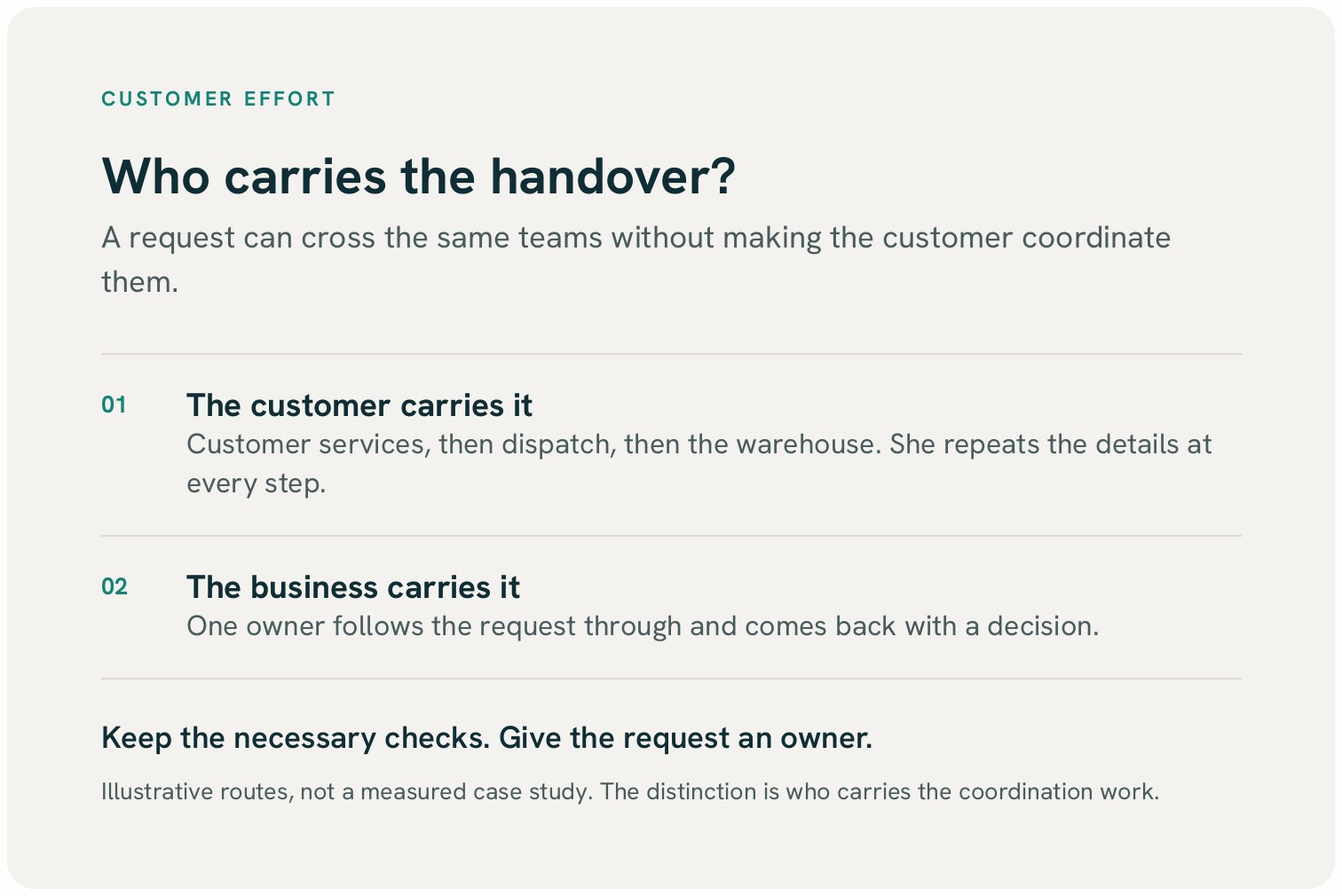
The website sends her to customer services. Customer services needs confirmation from dispatch. Dispatch needs the warehouse reference, which is different from the order number. She finds it, forwards it and explains everything again.
Everyone is polite. Nothing is resolved.
This is a hypothetical customer, but the job she has been given is recognisable: carry information between people who work for the same business. She is now your unpaid coordinator. She would rather have her Thursday delivery.
The work did not disappear
There is a seductive way to make a business process look more efficient. Move part of it outside the business.
Let customers find the right department. Let them reconcile the invoice and the order. Let them remember the last conversation. Let them work out whether the message confirming a request also confirms that anything will happen.
The work still exists. It has simply stopped appearing on your timesheet.
Some transfers are welcome. Booking an appointment without making a phone call can give someone more control. Updating an address online may be easier than spelling it out. Good self-service removes dependence on opening hours and a queue.
But a customer choosing to do something themselves is different from a customer being left to make your departments cooperate. One offers autonomy. The other offers homework.
In checkout research published in 2024, Baymard found that the work people must do within a checkout matters more than simply counting its screens. Its benchmark averaged 11.3 form fields, while its research suggested many checkouts could work with eight. Those are findings about retail checkout design, not a universal target for every service. The useful distinction is between the apparent length of a process and the effort it asks of a person.
A short form can require a long investigation. A single question can send somebody looking for a document they have never heard of.
Your organisation chart is showing
Return to the delivery. From inside the business, the handovers make sense. Customer services deals with customers. Dispatch plans movements. The warehouse identifies stock.
From outside, there is one business that agreed to deliver something.
The problem becomes visible in the words used to explain it. Another team owns that. The system does not let us. You will need to contact them directly. Each sentence describes an internal boundary as though it were a natural feature of the landscape, like a river the customer must cross.
There may be a genuine constraint behind it. A colleague may have no authority to change the booking. A supplier may control the vehicle. Different systems may hold different parts of the order. Pretending those constraints do not exist helps nobody.
Still, the customer should not have to discover the entire arrangement before receiving an answer.
A person can own the conversation without personally performing every task. They can carry the reference forward, explain what needs checking and say when the customer will hear back. If Thursday is impossible, they can bring back the available choices. The customer gets a decision instead of a new contact list.
The distinction is especially important when several businesses deliver a service together. Outsourcing the work does not automatically outsource the customer’s understanding of who made the promise.
Some friction earns its place
There is a reasonable objection here. Businesses ask questions for reasons. Checks can prevent fraud, protect privacy, avoid an expensive mistake or ensure that a customer understands a consequential choice.
A bank transfer should not become easier to authorise merely because a designer dislikes confirmation screens. A safety-critical order may need deliberate checks. A customer changing a delivery address may need to establish that the order is theirs.
The UK’s Competition and Markets Authority makes this distinction in its evidence review of online choice architecture. It describes excessive or unjustified friction as a potential source of harm, while recognising that friction can also support deliberation. Removing every pause is not the same as improving a decision.
So ask what a particular step protects.
Does it protect the customer’s money, consent or understanding? Does it prevent a real operational error? Or does it merely spare one department the trouble of talking to another?
In the delivery example, verifying the customer’s identity may be justified. Asking her to retype information already attached to the verified order may not be. The answer depends on the actual systems and permissions, but the two questions deserve separate treatment.
A useful safeguard should have an explanation. If nobody can explain why a step is necessary, its age is not much of a defence.
A better website cannot carry the whole argument
It is tempting to frame this as a website problem. Shorten the form. Rename the button. Add a chatbot.
Those changes can help. They can also give a faster front door to exactly the same maze.
If an answer requires three people to agree, the important question is who obtains that agreement. If a price depends on details, the important question is which details genuinely change it. If a customer needs to submit information, the important question is whether the business can explain why and help them provide it accurately.
The GOV.UK Service Manual advises collecting personal information only when it is a proportionate way to solve the problem, and minimising what is collected. That is guidance for government services, but it offers a useful design discipline for a business form: know why you need an answer before asking somebody else to find it.
Sometimes the improvement is technical. Sometimes it is permission for a colleague to make a routine decision. Sometimes it is a message that clearly distinguishes received, being checked and confirmed.
The customer does not need to know which kind of improvement it was. They need to know whether Thursday is happening.
Follow the request all the way through
A revealing exercise is to follow an ordinary request from the customer’s side, including the awkward middle and the eventual outcome. Do it with permission and appropriate privacy safeguards, rather than collecting people’s personal correspondence indiscriminately.
Notice every moment when the customer has to remember, translate, repeat, chase or guess. Also notice what each step achieves. A repeated question may reveal a poor handover, but it might be an essential independent check. The observation is the beginning of an investigation, not its verdict.
Look beyond the first response. A prompt acknowledgement can coexist with days of unresolved work. A friendly call can end by assigning another task to the caller. A process can meet every internal response target while the customer is still unable to arrange their week.
Small businesses have an advantage here: sometimes the people who can change the arrangement are already in the same room. They do not need a grand transformation programme to agree who carries a request across the boundary.
They may need to stop praising speed in one part of the process when it creates delay in another.
The customer wanted Thursday
Now imagine the same request handled differently.
The customer gives the order number and confirms the required details. Someone explains that dispatch needs to check capacity, takes responsibility for getting the answer and says when it will arrive. The answer comes. She can plan her week.
There was still work behind the scenes. There may even have been the same number of people involved. The difference is that the customer did not have to manage them.
It is worth asking where that distinction exists in your own business. When a customer says you are easy to deal with, perhaps they are describing something more valuable than a pleasant website or a cheerful voice.
Perhaps they mean they were allowed to remain a customer.
The next time somebody asks for Thursday, will you give them an answer, or a second job?