
The short answer. A big customer can fund the next stage of a business and quietly start choosing it, one reasonable request at a time. Before the next renewal, decide what the business wants to become, what it can commit to and what it needs in return.
The biggest customer can fund the next stage of a business. It can also start choosing that stage, one perfectly reasonable request at a time.
Picture a small manufacturer celebrating a renewal. Its biggest customer wants another year. The order book looks healthier, the workshop can plan ahead and the owner finally has a reason to approve the equipment everybody has been asking for.
Then the customer asks for a slightly different component. A different reporting format follows. Then a shorter lead time, a dedicated contact and a meeting every Friday.
None of the requests seems unreasonable. The relationship is valuable. The customer has helped the business become better at what it does.
A year later, the owner looks at the investment plan and notices something awkward. Nearly everything on it exists because this one customer wanted it.
Our manufacturer is hypothetical. Its question is worth asking: at what point does winning a customer start to feel like working for them?
The good news is real
A major customer can be a very good thing.
Regular orders can make planning easier. A demanding buyer can help a supplier improve quality, learn a market and develop capabilities it could not have funded alone. Familiarity can reduce the repeated effort of winning, explaining and setting up work for a succession of new accounts.
That is why “never depend on a big customer” is too simple to be useful.
Panos Patatoukas’s research, published in The Accounting Review in 2012 and summarised by UC Berkeley Haas, found benefits associated with a concentrated customer base. Suppliers in that research had lower gross margins but also efficiencies in areas including selling and administration, inventory and asset use. A headline margin did not tell the whole story.
This is research on supplier firms and capital markets, not a promise about a small workshop. It is nevertheless a useful challenge to the idea that a broad customer list is always better.
Losing a strong relationship in order to improve the appearance of a chart could be an expensive kind of tidiness.
The quiet acquisition happens in the diary
Formal ownership has paperwork. Informal control can arrive through the calendar.
Friday belongs to the account review. The senior engineer becomes the customer’s preferred contact. The next development slot goes to their modification. Other enquiries wait because an established relationship understandably comes first.
A request can be sensible on its own and still change the business when it becomes part of a pattern.
The manufacturer may have chosen a specialist strategy and be executing it well. Or it may be accepting a new strategy one small concession at a time. The order book alone does not distinguish between them.
One revealing question is what the business would build next if the biggest customer had no opinion.
If the answer is broadly the same, the relationship may be reinforcing a direction the owner wants. If the answer is entirely different, there is a decision to acknowledge. Perhaps following this customer is still the right move. It should at least be recognisable as a choice.
Dependence is easier to discuss before every alternative has become inconvenient.
Revenue share is only the first question
Customer concentration usually starts as arithmetic: how much of the business comes from a small number of accounts?
That matters. It does not capture everything that makes a relationship difficult to replace.
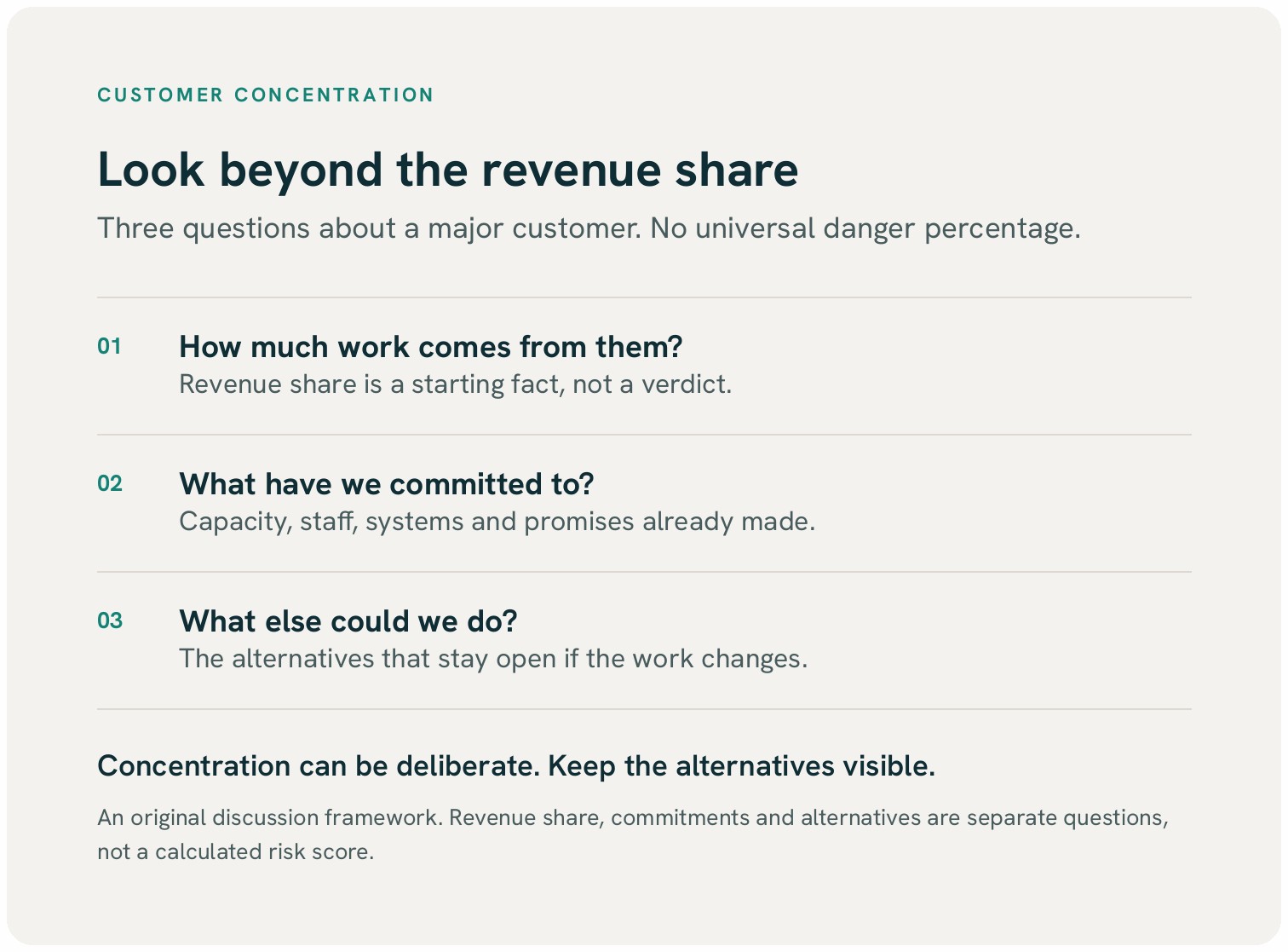
Consider two hypothetical suppliers with the same share of revenue from their largest customer. One uses standard equipment, holds skills that other buyers need and can redirect capacity. The other has invested in dedicated tooling and a specification with little use elsewhere. The revenue percentage is identical. The options are not.
Researchers Ling Cen and Sudipto Dasgupta describe both sides in their review of customer-supplier relationships: large customers can provide knowledge and operational benefits, while investments specific to a relationship and unequal bargaining power can expose suppliers to disruption.
For the owner, that suggests looking at revenue, commitments and alternatives together. Which costs would continue if orders fell? Which skills would still be useful? Which customer relationships have been allowed to go quiet? How much time would finding suitable replacement work actually take?
These are questions for the real business, not an argument for a universal danger percentage. A short contract and highly specialised capacity can create a different exposure from a durable agreement and adaptable work, even when the revenue chart looks reassuring.
Being valued and being available are different
There is another form of dependence that is harder to invoice: availability without a clear boundary.
The hypothetical manufacturer’s customer is not a villain. Its own team has deadlines, changing requirements and people to answer to. When a supplier keeps absorbing changes, the buyer may reasonably assume the arrangement is working.
Meanwhile, the supplier records the order as profitable but does not consistently account for the management attention, interrupted schedules and displaced work around it.
The result can be resentment built on an agreement nobody actually made.
A more useful conversation concerns what the relationship requires. If faster turnaround means keeping capacity free, that has a cost. If a dedicated person is essential, their role and cover need to be understood. If a change displaces another commitment, both parties should know that something is being displaced.
Payment belongs in the same conversation. A strong order book is not a substitute for dependable cash arriving. In a practitioner essay published by the UK’s Fair Payment Code, business leader Rob Hubbard argues that timely payment supports stability through the supplier chain, including smaller businesses further downstream. It is a buyer’s perspective on why squeezing the chain can eventually hurt the buyer too.
The details of a commercial agreement need proper consideration. The starting point is simpler: make the real work visible before treating every extra request as a test of loyalty.
Protect the relationship by keeping room to choose
The answer may be to do more with the customer.
A longer planning horizon, clearer change arrangements or jointly agreed investment could make specialisation more attractive. A good buyer may welcome a supplier who can explain what dependable delivery requires. Open discussion is not necessarily the beginning of a confrontation.
The answer may also be to preserve a modest amount of space elsewhere: time to develop another relationship, capability that serves several buyers, or an offer that does not depend on one customer’s internal language.
These alternatives have costs. Maintaining spare capacity is not free. Developing another market takes attention. Different customers may make incompatible demands. Diversification can add complexity without adding useful independence if all the new work depends on the same market or channel.
That is why the decision deserves more thought than “find more customers”.
For our manufacturer, the practical exercise might begin with the next equipment purchase. Is it valuable only inside this relationship, or does it strengthen a capability the business wants to own? If it is dedicated, does the commercial arrangement reflect that? What would a change in the customer’s plans mean for everyone who now depends on those orders?
A relationship can be concentrated and deliberate. The uncomfortable version is concentrated by default.
The renewal still deserves a celebration
Return to the workshop. The order is good news. People can plan. The owner can invest. None of that becomes less real because someone asks harder questions about the relationship.
The useful moment comes before the new requests become the next year’s unquestioned routine. There is still time to say what the business wants to become, what it can commit to and what it needs in return.
A major customer can help build that business. It can provide experience, confidence and work worth being proud of.
The danger is allowing gratitude to make every strategic decision in advance.
When the next renewal arrives, will you be celebrating a customer choosing your business, or discovering that they have already chosen its future?