
The short answer. When a tool does a beginner’s task, the business keeps the output but can lose the learning. Use some of the time saved to give junior people real thinking to do, with feedback, so someone is ready for the hard work later.
Beginner tasks often have two outputs: something the business needs and something the beginner learns. When the task changes, the second output needs an owner too.
Imagine a junior account executive receiving a beautifully organised summary of a difficult customer call. The decisions are clear. The actions are tidy. A tool produced it before she had finished opening her notes.
Her manager is delighted. That used to take an hour.
Then the manager asks why the customer resisted the proposed date, which promise matters most and whether the next message should reassure, challenge or ask another question. The summary contains the words. It does not tell the manager what the junior colleague understood.
This is a hypothetical scene, not an argument for making somebody transcribe calls by hand. It asks a less comfortable question: when a business removes beginner work, does it know what learning was attached to it?
The task had a second purpose
A junior task can produce two things. There is the work the business needs today, and there is the experience the person may use tomorrow.
Preparing a draft can reveal what is missing from a brief. Checking an order can teach which exceptions matter. Listening to a call can expose the distance between what a customer requests and what they are worried about.
None of this means every repetitive task is an education. Some drudgery is simply drudgery, and businesses have sometimes called it development because that sounds better than admitting nobody senior wants to do it.
The useful question is what someone is expected to learn, and how the business will know they have learned it.
The UK’s 2024 Longitudinal Small Business Survey found that 45 per cent of SME employers had arranged or funded staff training or development in the preceding year. Provision varied sharply by size: 39 per cent of micro businesses, compared with 82 per cent of medium-sized businesses. These are employer-reported figures about training provision, not a verdict on the quality of daily learning.
They do remind us that development already competes with the immediate demands of running a business. A faster way to produce the output will not automatically create time to teach the judgement.
Assistance can be a very good teacher
It would be a mistake to assume that learning requires struggling without useful tools.
A well-designed aid can expose a beginner to examples they would otherwise take months to encounter. It can help them find information, understand a possible approach and compare their first attempt with another answer. The manager may then spend less time correcting routine mistakes and more time discussing decisions.
There is relevant workplace evidence. In the published 2025 version of Generative AI at Work, Erik Brynjolfsson, Danielle Li and Lindsey Raymond studied 5,172 customer-support agents. AI assistance increased issues resolved per hour by 15 per cent on average, with larger benefits for less-experienced and lower-skilled workers. The researchers also found evidence consistent with learning.
This was one software company’s support setting, and most agents were outside the United States. It is not a representative result for US or UK junior employment, nor a guarantee that any tool will produce the same effect.
It does show why “protect the old tasks at all costs” is the wrong ambition. The route into expertise can change and improve.
Our account executive might learn more from comparing the generated summary with a senior colleague’s reading of the call than from spending an hour making a tidy document nobody discusses.
A correct answer can hide a missing lesson
The opposite outcome is possible too.
A study by Hamsa Bastani and colleagues, published in PNAS in 2025, examined AI assistance in high-school mathematics in Turkey. Students with a general-purpose-style tutor performed better during assisted practice but worse on a subsequent unassisted assessment than the control group. A version designed with learning safeguards largely removed that negative effect.
School mathematics is not account management. The experiment does not establish that junior employees are losing skills, and its short-term results cannot answer every question about long-term expertise. It does establish why assisted performance and learning should not be treated as interchangeable.
That distinction is easy to lose at work. A polished draft is visible. The ability to recognise a misleading assumption may stay invisible until something goes wrong.
The manager can therefore ask a second kind of question. What did you change, and why? What would make this answer unsuitable? Which part would you verify? What do you think the customer will do next?
Those questions are not an examination designed to catch somebody out. They make reasoning discussable while there is still time to improve it.
If the only feedback a junior person receives is approval of the finished output, the business may not discover what they can explain, challenge or do independently.
The apprenticeship was always designed
The word apprenticeship can make this sound like a return to an older world. Its useful principle is thoroughly practical: work and learning need a deliberate relationship.
The US Department of Labor describes apprenticeship as combining paid work experience with job-related instruction and mentoring. Formal schemes have their own requirements, but the combination is worth noticing. Being present in a workplace is not the whole model.
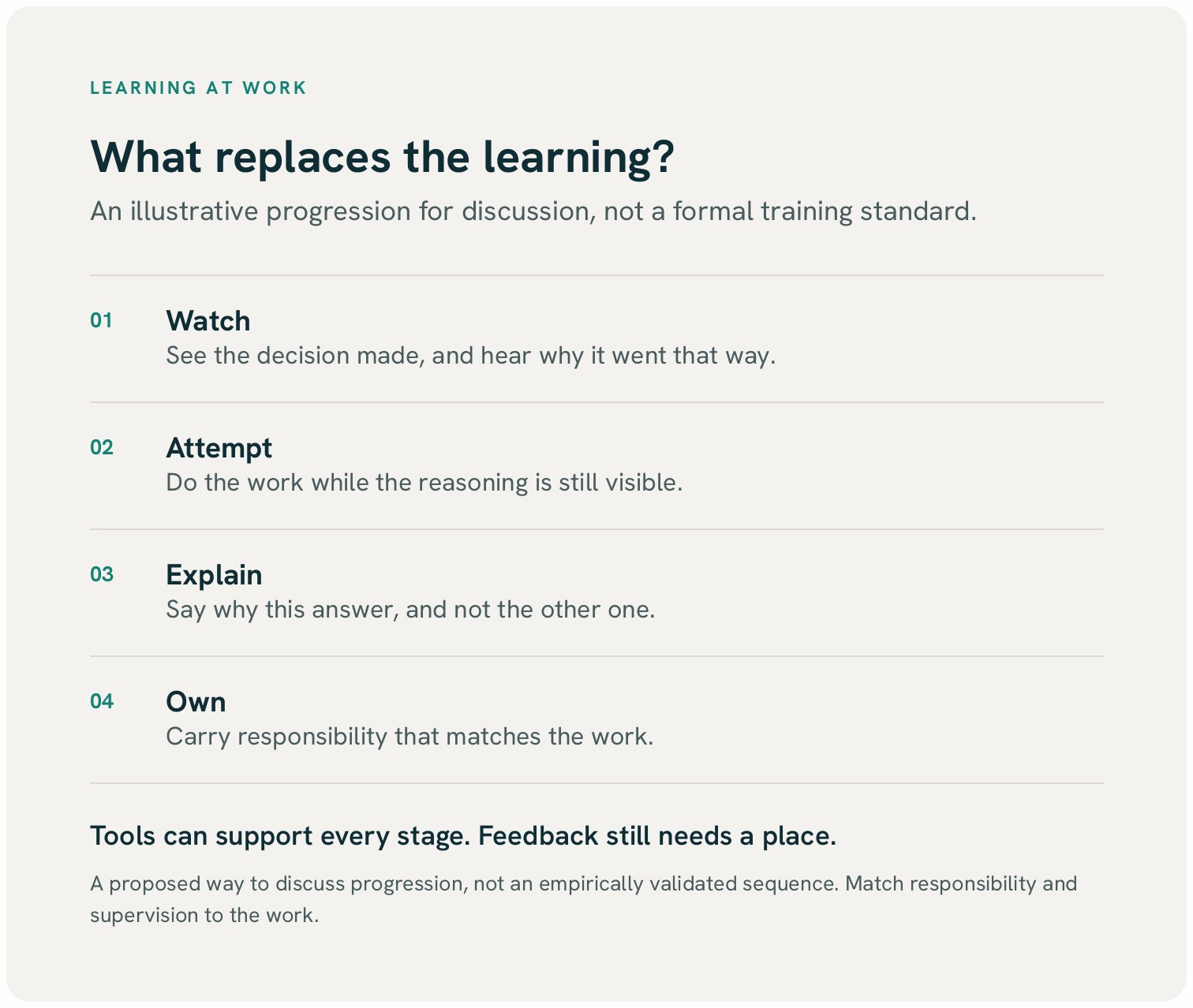
A small business does not need to pretend an informal training arrangement is a registered apprenticeship. It can still be explicit about the progression from watching a decision, to attempting it, to explaining the reasoning, to owning an appropriate part of the work.
Each stage needs feedback. Watching without discussion can leave the important reasoning hidden. Attempting without support can create avoidable harm. Explaining without ever receiving responsibility can become an endless rehearsal.
The work also needs to be safe and suitable. Nobody should be given an uncontrolled customer, financial or technical risk merely to prove that they can learn from mistakes. Practice can use an anonymised past situation, synthetic material or a limited task with review before anything goes out.
Tools can belong throughout that progression. The question is whether they help the learner see and test the reasoning, or simply conceal the need to develop it.
Someone has to have time to teach
There is a cost that a discussion about learning can politely avoid: experienced people need time to help.
A senior colleague cannot repeatedly explain difficult judgement while being measured as though every minute were available for individual output. If mentoring is always the first thing cancelled when work gets busy, the business has chosen a development policy, even if nobody wrote it down.
Small firms feel this sharply. There may be no training department and no spare expert. A founder might be the only person who can explain a particular decision.
That makes a modest, repeatable commitment more credible than a grand promise. Keep a useful example. Discuss the difference between two possible replies. Let the junior colleague propose a decision before hearing the senior answer. Revisit a task later to see what has transferred.
Those are options to test, not a universal training formula. Different work requires different supervision and professional standards. The essential commitment is to notice development alongside delivery.
It also means allowing the junior person to improve the method. A new colleague may see a better route precisely because they have not spent years accepting the old one. Teaching judgement should not become a way to reproduce every habit of the person doing the teaching.
The summary is still useful
Return to the call. The account executive has the generated summary. The manager has a choice.
They can accept the document, tick off the task and move on. Or they can use some of the time saved to discuss what the summary does not settle: the customer’s hesitation, the uncertain promise and the next decision.
The tool does not have to be removed for that conversation to happen. The old hour of administration does not have to return. What has to remain is an opportunity for the junior colleague to do some thinking that matters, receive feedback and gradually take responsibility for more of it.
A business can become much faster at producing today’s work while paying too little attention to who will understand tomorrow’s difficult work.
The next time an easy task disappears, will its learning disappear with it, or will someone design a better way in?