
The short answer. A business can have cover and owners for everything and still route its decisions back to the founder. A week away shows which everyday decisions need agreed limits, written context and clear permission to finish without you.
The team had cover. The work had owners. The phone kept ringing. A week away can reveal what an organisation chart leaves out.
On Sunday evening, the suitcase is by the door and the out-of-office message is ready. The founder has arranged cover, handed over the urgent work and told the team to call only if something important happens.
By Monday lunchtime, three people have called. One needs a discount approved. One cannot find the background to a customer’s special arrangement. One wants reassurance before making a decision they have technically been allowed to make for months.
Imagine this in a small, established business with capable people and customers who like it. Nothing dramatic has failed. The founder can answer each question in a minute.
By Tuesday, the holiday contains most of a working day, distributed across the gaps.
The business has staff. It has procedures. It has someone covering the founder’s role. What it does not quite have is permission to continue without them.
Being needed can feel like proof
For a founder, being the person who can resolve things is part of the job’s appeal.
You remember why a customer was promised something unusual. You know which supplier will help in a hurry. You can tell when a technically reasonable answer will damage a relationship. Those abilities have value, and the business may owe a great deal to them.
The difficulty is that valuable judgement and habitual approval can arrive through the same phone.
A serious decision and a routine exception both begin with a colleague asking for a minute. The founder responds because it is quicker than explaining. The customer is helped. The team moves on. The next similar question still has the same destination.
Nobody has behaved badly. The arrangement rewards itself.
Research by Ufuk Akcigit, Harun Alp and Michael Peters models firm growth around a real constraint: the entrepreneur has a limited amount of time for daily operations. Their 2021 paper uses data from the United States and India to examine how conditions for delegation affect growth. It is an economic model, not a diagnosis of every owner-led firm, but it makes the bottleneck easy to recognise.
A business can add people faster than it adds places where decisions are allowed to finish.
A handover can move tasks and leave decisions behind
Our hypothetical founder did hand things over. There was a list. It named the people covering customers, suppliers and the day’s work.
What the list did not contain was the reason behind the unusual discount, the boundary around an acceptable compromise or the circumstances in which somebody should stop and ask for help.
Those are harder to transfer than tasks.
A colleague might know what needs doing but lack the information to choose between two options. They might have the information but no authority to act. Or they might have both and still expect the founder to reverse a decision that was reasonable but different from the one the founder would have made.
From the outside, all three situations can look like a team that needs more confidence. Confidence alone will not repair missing context or unreliable permission.
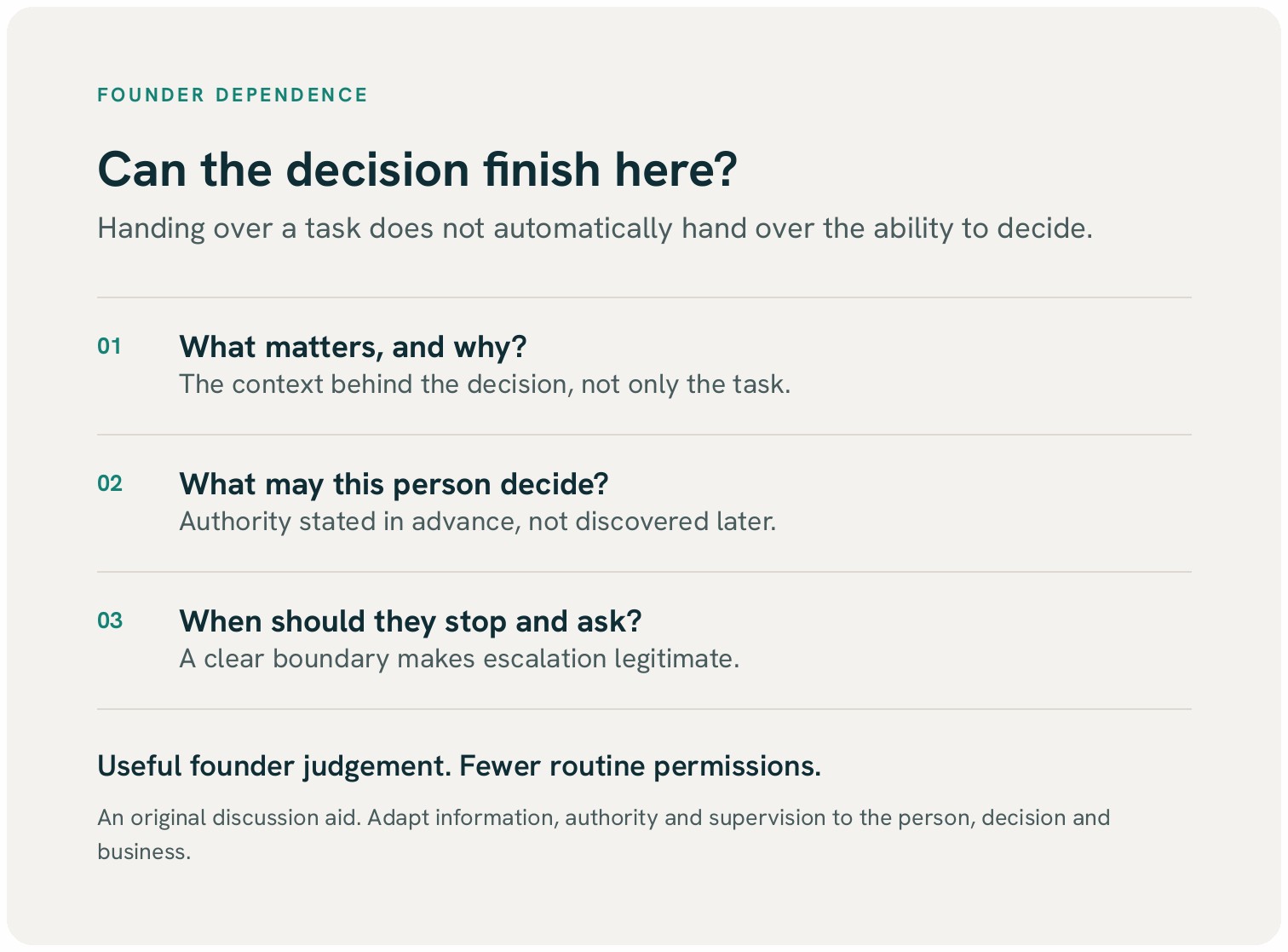
A useful handover therefore needs to explain what can be decided, what information matters and where the boundary sits. It should also establish what a colleague can expect afterwards: a discussion of the reasoning, rather than a surprise rule invented once the outcome is known.
That does not mean every decision is acceptable. It means the criteria should be intelligible before somebody is asked to use them.
Context is part of control
A founder who hesitates to delegate may have legitimate concerns. They may have seen a promise made without understanding its cost, a customer relationship mishandled or a small exception quietly become permanent.
The answer cannot simply be to trust harder.
Research from a management experiment in Indian textile firms offers a useful, carefully bounded observation. An early paper by Nicholas Bloom and colleagues reported that improved information flow helped owners delegate more decisions to middle managers. The work concerns a particular manufacturing setting and a wider management intervention; it does not establish that a document alone creates trust.
It does suggest that control and delegation need not move in opposite directions. An owner may become more comfortable sharing decisions when the relevant information and reasoning become easier to see.
For the hypothetical business, the customer arrangement could have a short record explaining what was agreed, why and when it should be reviewed. The discount could have an understood range and a clear route for exceptions. A colleague could know which commitment they may make without first finding the founder on a beach.
Some matters should still come back. A major commercial change, a safety issue or a decision outside somebody’s competence may need specialist or senior involvement. A boundary is useful precisely because it makes the ordinary space inside it usable.
The week away is a question, not a qualification
There are businesses in which the owner’s personal work is the product. A specialist practitioner, artist or sole trader may deliberately choose an enterprise that depends on their presence. That is not a failed version of a larger company.
Even in a growing team, there will be periods when handing over is difficult: a major launch, an unusual contract, a newly hired colleague or a genuinely scarce skill. A neat holiday test can become another unfair standard if it ignores those circumstances.
The question is whether dependence is understood and chosen, or simply discovered when the owner tries to leave.
Continuity planning makes the same practical concern visible without the holiday. Swindon Borough Council’s business-preparedness guidance asks businesses to consider what happens when key staff are unavailable. Illness and disruption do not necessarily arrive after a convenient handover week.
A planned absence can offer a gentler way to learn. It does not need to begin with the founder becoming unreachable. It can begin with one routine category of decision being handled by somebody else, with appropriate cover and a clear exception route.
Notice where the work waits. That is information about the arrangement, not a reason to embarrass the person waiting.
Let somebody else finish the decision
A founder can delegate the task and still keep the final moment.
The colleague prepares the answer. The founder rewrites it. The colleague recommends an option. The founder selects it. The work is distributed, but the business still waits for one person’s attention before moving.
Sometimes that final review is necessary. When it is always necessary, the founder should ask what would have to change for one class of ordinary decisions to end somewhere else.
The answer may involve training, better information, a revised authority limit or a clearer agreement with a customer. It may also involve the founder tolerating a different acceptable answer.
That last part is uncomfortable. A decision can be competent without sounding like the owner. A customer can be well served without receiving the owner’s preferred wording. If every stylistic difference triggers an intervention, the team learns that permission lasts only until the founder sees the result.
There should still be review and learning. A short conversation about a decision can surface a missing assumption or improve the next one. The purpose is to strengthen somebody else’s judgement, not to demonstrate that the founder could have done it differently.
Over time, the most useful sign may be fewer routine questions and better exceptional ones. The founder is still involved where their involvement matters. The ordinary work has somewhere else to go.
Tuesday could belong to somebody else
Return to the holiday. The phone may still ring. A genuinely unusual problem may deserve the founder’s attention.
But the discount has an agreed boundary. The customer arrangement has enough context for somebody else to explain it. The colleague with the reasonable decision has permission to make it and knows when to ask for help.
The founder has not become irrelevant. Their earlier judgement has become more available to the business, instead of remaining accessible only through their immediate presence.
There is something worth building there, even for an owner who loves being involved. A business that can carry more of its ordinary decisions gives the founder more choice about where to contribute.
The suitcase was never really the test. It merely made the questions arrive at a less convenient time.
When the next routine decision comes in, will you answer it again, or help it find somewhere else to finish?