
The short answer. The claim that 70 per cent of change programmes fail has no evidence behind it; it grew out of a 1990s estimate its authors called unscientific. But good advice really does go unacted on, usually because nothing was removed to make room for it, nobody with authority owns it, or it fits the average business rather than this one.
The most quoted number in change management was invented. The thing it points at is real, and it is not a knowledge problem, which is awkward for anybody whose product is knowing things.
Seventy per cent of change programmes fail.
You have heard it. It is on slide four of a great many presentations, mine included over the years. It is the number that justifies the change management workstream, the communications plan and the fee attached to both.
There is no evidence for it.
Where the number came from, which is nowhere
In 2011 Mark Hughes published a paper in the Journal of Change Management with the admirably direct title Do 70 Per Cent of All Organizational Change Initiatives Really Fail?
He took five published instances of the claim and followed each one back. The pattern was the same every time. A source either stated the figure without evidence, or cited another source that stated it without evidence. Nobody had measured anything. There was no study at the bottom of the pile, because there was no bottom of the pile.
Hughes traced a plausible origin to the business reengineering literature of the 1990s, and to a sentence that described itself accurately at the time. Our unscientific estimate, it said, is that as many as 50 to 70 per cent of organisations undertaking a reengineering effort do not achieve the dramatic results they intend.
An unscientific estimate, clearly labelled as one, about a specific kind of project, concerning whether the results were as dramatic as hoped. Thirty years of citation turned it into a law of nature about all change everywhere, and removed the word unscientific on the way.
There is a joke here that I am obliged to make at my own expense. A profession that sells rigour has spent three decades quoting an unsourced number in order to sell rigour, and the number was produced by the same profession.
The same thing happens to the other famous number
If you have spent time near healthcare or research policy, you will have met the figure of 17 years: the time it supposedly takes for research evidence to reach clinical practice.
In 2011 Morris, Wooding and Grant went looking for it, in a paper titled The answer is 17 years, what is the question. They reviewed 23 studies and found estimates ranging from under one year to more than 300. The studies, they concluded, were almost never measuring the same thing: different start points, different end points, different fields, different definitions of what counts as arrival.
The convergence around 17 was not a finding. It was a coincidence that people found comfortable enough to repeat.
Which brings me to the part where I stop enjoying this.
Both numbers are fiction. Both point at something real
It would be convenient to conclude that change usually works fine and everybody has been scaremongering. That is not available either, because the evidence against the statistic is not evidence against the phenomenon.
Anybody who has worked inside a business for more than a few years has watched a recommendation that everybody agreed with quietly fail to happen. Not rejected. Not argued about. Agreed, minuted, and then absent.
Jeffrey Pfeffer and Robert Sutton gave this its name in 2000, in The Knowing-Doing Gap. Their central observation was that organisations very rarely fail because nobody knew what to do. They fail because knowing was allowed to substitute for doing, and because talking about a decision felt sufficiently like making one.
That is a harder problem than ignorance, and it responds to none of the same treatments.
Four reasons good advice evaporates
Having produced a fair amount of advice that went nowhere, I can offer a more specific account than the general one.
It assumed a person who was never going to do it. A great many recommendations quietly depend on somebody behaving differently from how they have behaved for nine years. Everybody in the room knows this and nobody says it, because saying it is a conversation about a person rather than about a process. The plan is then correct and inert.
Nothing was removed. A recommendation that adds work to a full week, without naming what stops, is a wish. The week is already spoken for. Adding to it does not produce more output, it produces a queue, and the new thing goes to the back of it because it has the least momentum.
It had no owner with the authority to finish. Plenty of work is assigned to somebody who can start it but cannot conclude it, because concluding requires a decision that belongs elsewhere. The work then travels as far as that boundary and stops, and it looks like a motivation problem rather than a permissions one.
It was right in general and wrong here. The most uncomfortable of the four. Good practice assembled from a hundred other businesses is an average, and the business receiving it is not the average. The apparently inefficient process sometimes exists because of a constraint that appears in no document and nobody thought to mention.
Which makes the document the least valuable part
This is not a comfortable conclusion for a business that sells advice, so it is worth stating rather than implying.
If the analysis was right and nothing changed, then the analysis was not the scarce thing. The scarce thing was whatever would have made it happen: an owner, a removal, a decision somebody was willing to be accountable for, and a plan that accounted for the actual people in the actual business.
I have made an adjacent argument before, about what happens to advice when machines can produce the document. This is the older version of the same problem and it does not need any technology in it. The deliverable was already the cheap half. Software has only made that harder to hide.
The deliverable is the part that is easy to produce, easy to admire and easy to charge for. It is also the part that can be entirely correct while the engagement achieves nothing, and the record of the work looks identical either way. A bound report sitting unread is indistinguishable, on paper, from one that changed a business.
I do not have a clean answer to that. I have a preference for doing less and finishing it, which is commercially worse and professionally better.
Four questions worth asking before accepting any recommendation
These apply whether the advice came from a consultant, a board member, a well regarded book or your own notebook at half past eleven at night.
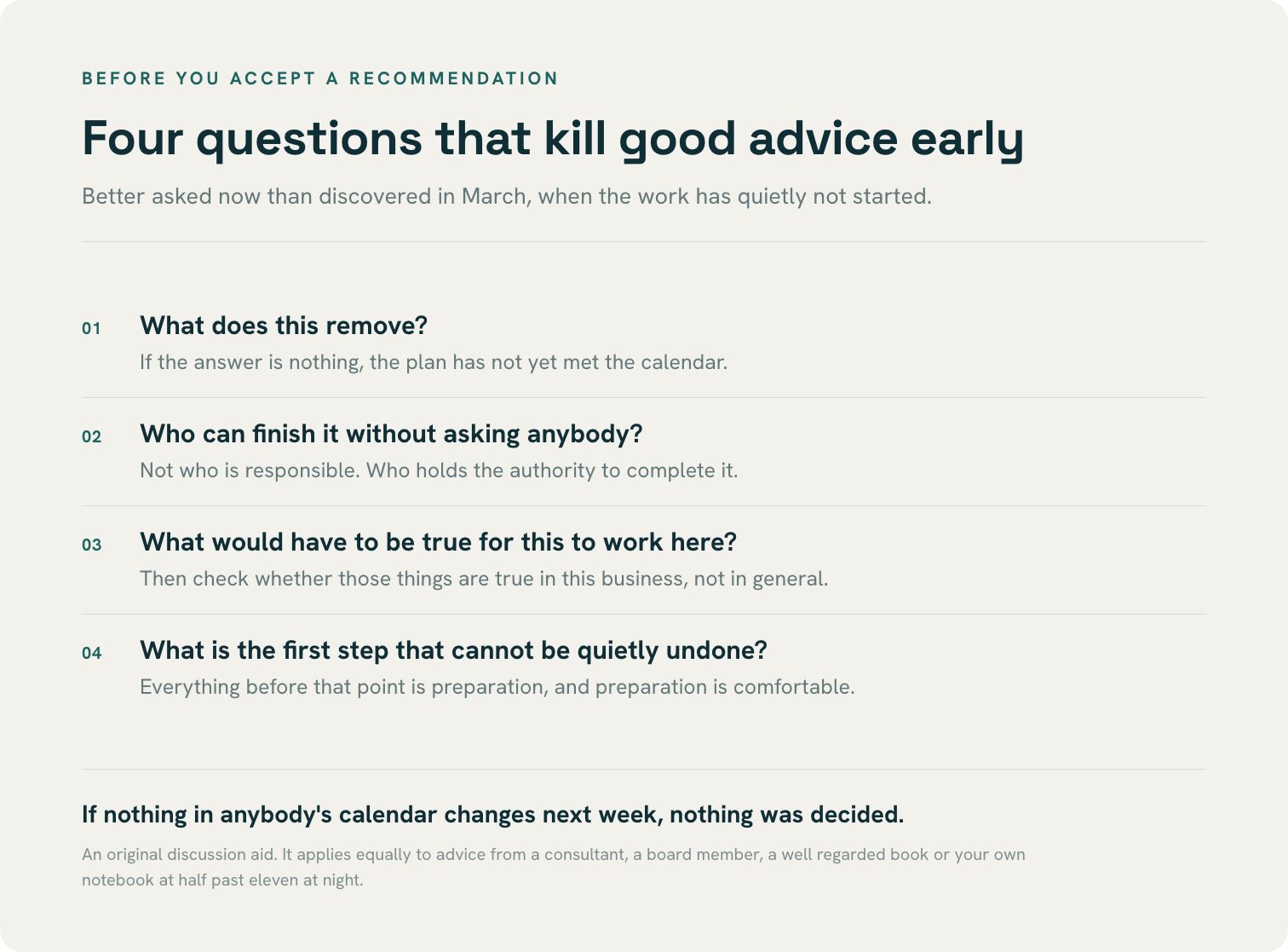
What does this remove? If the answer is nothing, the plan has not yet met the calendar.
Who can finish it without asking anybody? Not who is responsible. Who has the authority to complete it.
What would have to be true for this to work here? Then check whether those things are true. This single question kills a surprising proportion of good advice, and it is better killed now than in March.
What is the first step that cannot be quietly undone? Not the first task. The first commitment that makes reversal awkward. Everything before that point is preparation, and preparation is where good intentions go to live comfortably for a long time.
There is a cruder version of the whole test, and it works nearly as well. If nothing in anybody’s calendar is different next week, nothing was decided. Something was discussed.
The ranking was wrong. The warning was not
The 70 per cent is invented, and it should stop being quoted, including by me.
What it was doing all along was standing in for something everyone recognises and nobody has a clean measurement for. Businesses know more than they act on. The knowing is the cheap part, and it has become cheaper still in the last three years, which raises rather than lowers the value of being able to make something actually happen.
The report was right. That was never the difficult bit.
If nothing in anybody’s calendar changed last week, what was decided in the meeting before it?