
The short answer. A fractional project manager is an experienced PM who joins your business for one to three days a week for the life of a project. They own the scope, schedule, risks and suppliers, then hand the result over to your team. It suits a defined project, such as a software build or a process overhaul, where a permanent hire would be slower and costlier.
Most growing businesses reach a point where important work is flying around in spreadsheets, email threads and meetings that end without a clear owner. The project exists. The deadline exists. But nobody is professionally accountable for the outcome.
A fractional project manager closes that gap without the overhead of a permanent hire. If your business is running something significant, from a software build to a process overhaul, it is worth understanding how this model works and when it makes sense.
Why projects go wrong without a dedicated owner
Projects without a professional owner do not fail all at once. They drift: updates become less frequent, decisions take longer, small risks grow quietly until they become expensive surprises.
The data is consistent. PMI’s Pulse of the Profession 2025 found that poor project performance wastes an average of 11.4% of every pound invested. For a £200,000 initiative, not unusual for a system migration, software build or brand relaunch, that is £22,800 gone before the business sees any return.
The root cause is almost always the same: someone is responsible, but nobody is accountable.
What a fractional project manager actually does
A fractional project manager is an experienced PM who joins your business for a defined number of days per week, typically one to three, for the life of a project. They are not a consultant who delivers a report and leaves; they are the person who chairs the weekly call, owns the risk register, chases the actions and tells you when something is going wrong before it becomes a crisis.
In practice, that means:
- Defining the scope, schedule and success criteria at the outset
- Maintaining a single, visible view of progress for all stakeholders
- Managing suppliers, developers or agencies on your behalf
- Flagging and resolving issues as they arise, rather than after the deadline has passed
- Handing the finished outcome over to your team with documentation and lessons learned
For businesses commissioning a software build or process transformation, this is the role that makes the difference between a project that delivers and one that stalls.
Full-time hire versus fractional: the numbers
Start with the permanent hire. According to the Association for Project Management’s Salary and Market Trends Survey 2025, the average project manager in the UK now earns £52,500 per year. Add employer National Insurance, pension contributions and a recruitment fee and the real cost of a permanent hire is closer to £70,000 before a single task is completed.
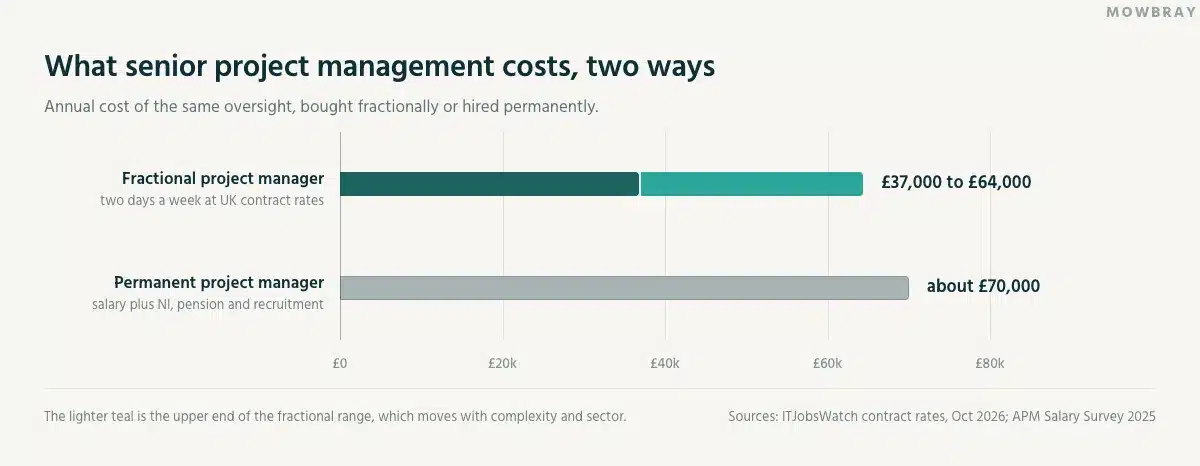
A fractional PM is usually paid a day rate. UK contract project managers were advertised at a median of £535 a day in the six months to October 2026, with most between £400 and £700 (ITJobsWatch). Two days a week across a working year is roughly 92 days, so £37,000 to £64,000. One day a week halves that.
So at two days a week the saving over a permanent hire is real but smaller than most articles on this topic claim. The stronger case is the other three things you buy: someone senior from day one, a start measured in days rather than months, and a cost that stops when the project does.
| Full-time PM | Fractional PM | |
|---|---|---|
| Typical annual cost | £65,000 to £90,000 (inc. on-costs) | £37,000 to £64,000 at two days a week; about half that at one day |
| Seniority level | Variable | Senior by design |
| Time to onboard | 4 to 8 weeks | Days |
| Notice period to exit | Months | Weeks |
| Best suited to | Ongoing programmes | Defined project or phase |
When it makes sense for your business
A fractional arrangement works best when:
- You have a significant project, six months or longer, meaningful budget, but no permanent project management resource in-house
- You are commissioning a software build or system implementation and need someone to hold the supplier accountable
- Your business is scaling quickly and operations are changing faster than your team can manage
- A project has stalled and needs a reset and a clear owner
- You need a single point of contact across multiple workstreams or suppliers
It is not the right fit if what you need is day-to-day operational management rather than project leadership, that is a different role and a different conversation.
The single accountable partner advantage
For many owner-led businesses, the deeper problem is that projects touch multiple workstreams, technology, process, brand, external suppliers, and no single person holds all the threads. A fractional PM can sit across those boundaries in a way that a specialist contractor cannot.
When project management is built into a wider partnership, one that already understands your processes and software delivery and has been part of the original planning, you get continuity of context rather than a series of handoffs. That is how work actually gets to the finish line.
If you have run a business process review and know where the inefficiencies are, the next question is often who will be accountable for fixing them. That is precisely where fractional project management fits.
If you have a project that matters but no one to run it, talk to Mowbray. We can help you scope whether fractional project management is the right next step, and act as your single accountable partner from that conversation through to delivery.
Frequently asked questions
How much does a fractional project manager cost in the UK?
Most charge a day rate. UK contract project managers were advertised at a median of £535 a day in the six months to October 2026, mostly between £400 and £700, so two days a week works out at roughly £37,000 to £64,000 a year and one day a week about half that. A permanent project manager, once you add National Insurance, pension and recruitment, is closer to £70,000.
When should a business use a fractional project manager?
It works best when you have a significant project of six months or longer but no permanent project management resource in-house, when you are commissioning a software build or system implementation, or when a project has stalled and needs a clear owner.
How is a fractional project manager different from a consultant?
A consultant typically delivers a report and leaves. A fractional project manager is accountable for the outcome: they chair the weekly call, own the risk register, manage suppliers and see the project through to delivery.
How quickly can a fractional project manager start?
Onboarding usually takes days rather than the four to eight weeks a permanent hire needs, and the arrangement can be wound down in weeks once the project is complete.
From the archive
- The US AI executive order moved AI governance into procurement
- The post-SVB review sharpened the lesson: growth can outrun controls
References
- Project Management Institute, Pulse of the Profession 2025, pmi.org
- Association for Project Management, Salary and Market Trends Survey 2025, apm.org.uk