
The short answer. The stretch between launch and the tenth paying customer decides more than the idea does. Make buying easy, put the business in front of one real person who fits, find out what stopped them if they do not buy, and repeat. The break-even calculator shows how many sales a month cover your costs.
Starting has never been easier. The stretch between opening day and the tenth paying customer has never been quieter. What happens in it decides more than the idea does.
Three weeks ago, you launched.
The website is live. The payment system works, you think. You have checked your phone six times since breakfast and none of the notifications is an order. Friends have said kind things. Nobody you do not know has bought anything yet.
This is the part we leave out of stories about starting a business, and it is where a surprising number of them quietly end.
Starting has never been easier. The next bit has never been harder.
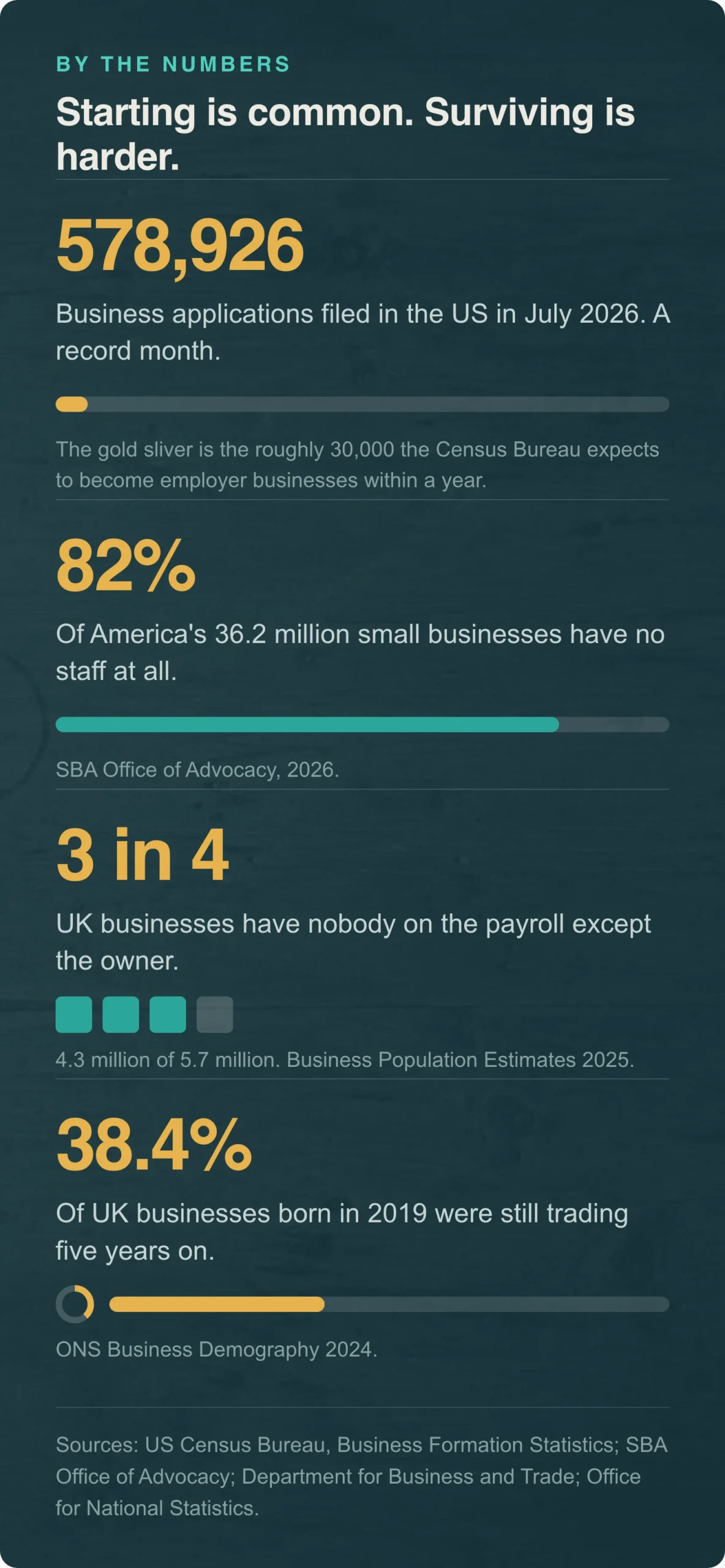
In July 2026, 578,926 business applications were filed in the United States, according to the US Census Bureau. That is a record, and it needs a qualification. An application is a tax number, not a shop with the lights on. The Census Bureau’s own projection is that around 30,000 of those applications will become businesses with a payroll within a year. The rest will stay small, stay solo, or stay an idea. Still, well over half a million people in a single month decided to have a go.
The UK is already home to about 5.7 million private sector businesses, and 4.3 million of them have nobody on the payroll except the owner, according to the 2025 Business Population Estimates. Three in four. The US has 36.2 million small businesses, and the Small Business Administration says 82 per cent of those have no staff either. In both countries, most of what we call the economy is one person doing rather a lot of the business.
You can register a company, buy a domain, draw a logo, open the social accounts and start taking payments without leaving the kitchen table. That is the good news. The less convenient news is that everyone else can too. So the question that used to be “how do I start” has become “how do I get my first ten customers”, and that is a different problem.

Why do the first ten customers matter most?
Customer number 100 arrives at a business that has already learnt quite a lot. Customer number one does not. They arrive while you are still discovering whether £40 is too much or £20 too little, whether the delivery box is the wrong size, and whether anybody understands the second sentence on your homepage.
That is why the first ten matter. They are not ten sales. They are ten small tests of whether the business works outside your head. Did somebody understand what you were selling? Did they trust you enough to pay? Could you deliver what you promised? Did they come back? Would they tell anyone? By customer ten there is usually a little evidence where before there was mostly optimism.
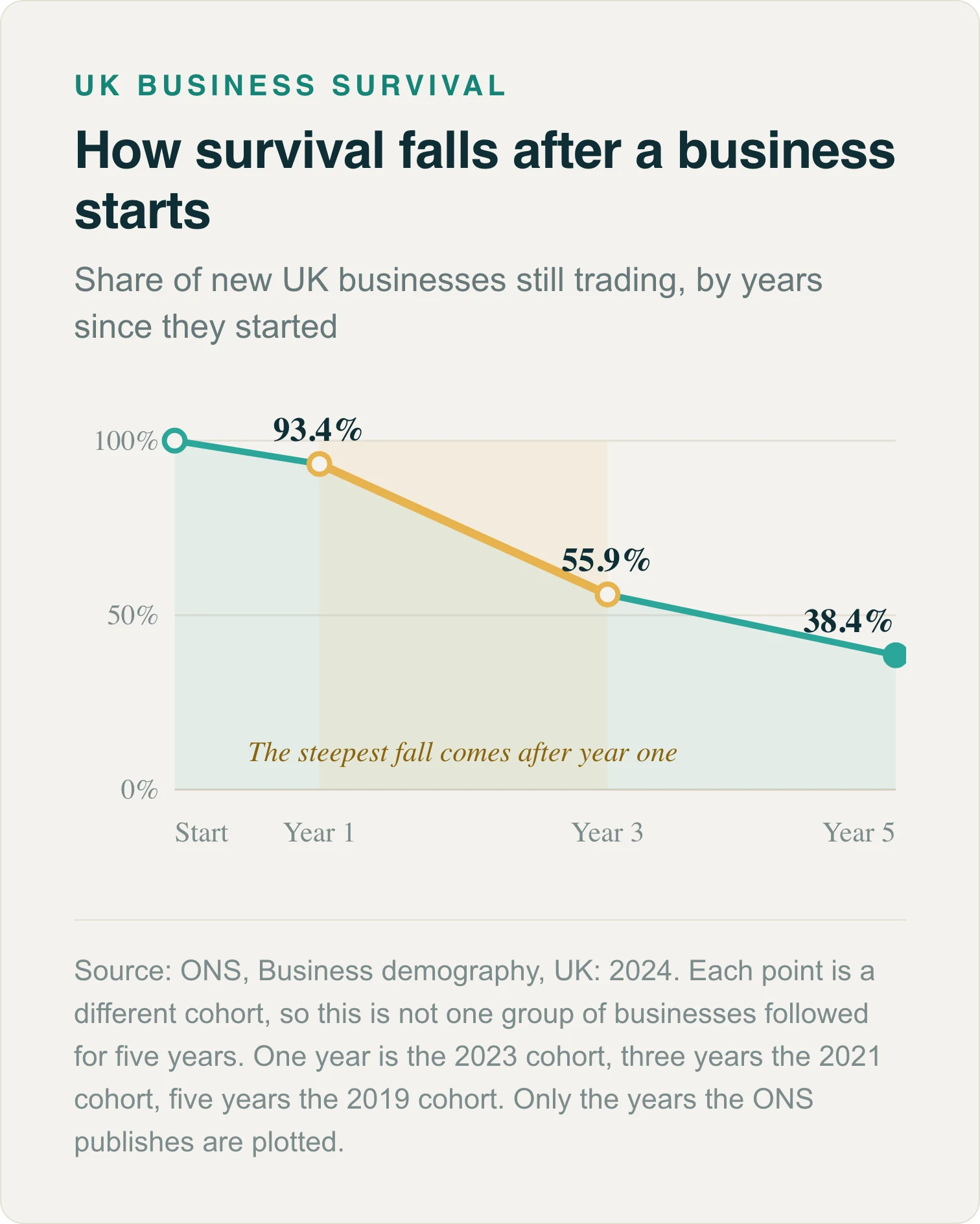
The odds explain why that evidence matters. US Bureau of Labor Statistics data has long shown that around one in five new establishments do not survive their first year, and around half do not reach five. In the UK, the Office for National Statistics found that 38.4 per cent of businesses born in 2019 were still trading five years later. The two countries count differently, so a league table would be unwise. But the UK figures show something useful about timing. The first year is not where the damage is done. Ninety-three per cent of new UK businesses survive it. Survival then keeps falling sharply, once the novelty of launching has worn off and the business has to start producing repeatable demand. Repeat customers, reviews and word of mouth are what slow the fall, and the first ten customers are where they start.
They are not ten sales. They are ten small tests of whether the business works outside your head.
A stranger needs surprisingly little before they can trust you
Friends are terrible test customers. Not because they are unkind. Because they already know you. A stranger has none of that stored trust. They have landed on your website because somebody mentioned you, they saw a post, they searched, or they walked past. Now they are deciding whether you are real.
For a new business, four fairly ordinary things do most of that work.
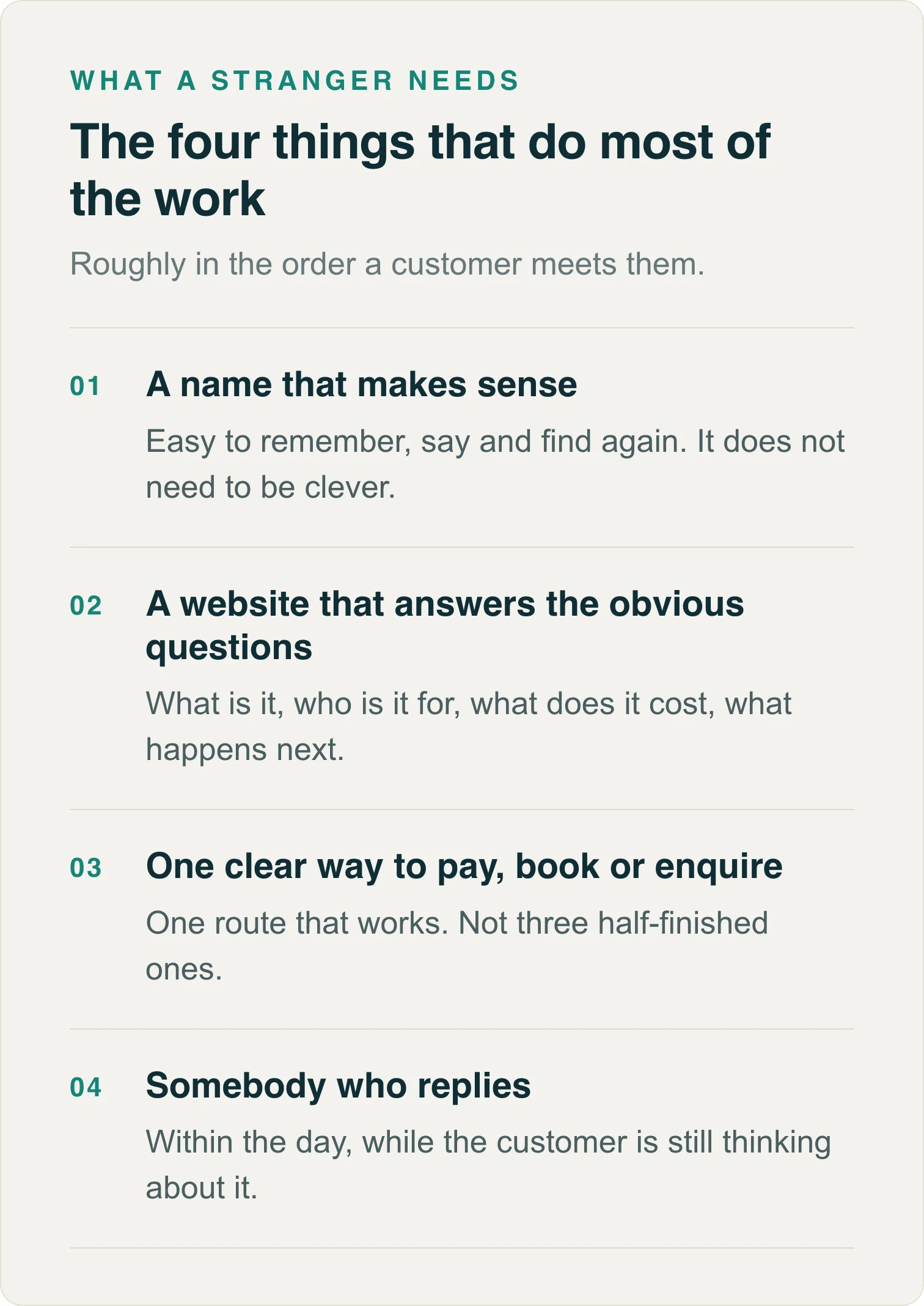
That last one sounds almost insultingly obvious. It stops being obvious when the same person is doing the work, answering email, chasing an invoice, posting on Instagram and trying to remember the password for the accounting software.
Imagine a florist in Guildford who has just started doing flowers for small weddings. The first version of that business does not need a customer portal. It needs good photographs, clear prices or price ranges, a straightforward enquiry form, and someone answering it while the couple are still thinking about flowers. None of this is exciting. That is rather the point. Trust is mostly built from boring things working properly.

The businesses that get through start narrower than they intend to stay
One of the strangest instincts in a new business is to make the market as wide as possible. Homeowners and businesses. Start-ups and established firms. London and the rest of the country. Perhaps America as well. It feels safer. Usually it makes finding the first ten customers harder, because you cannot stand in front of everybody.
If you need ten customers, you do not need everybody. You need to know where ten plausible people are. That changes the question from “how do we market this business” to “where could I find ten independent restaurant owners within twenty miles”, which is a problem you can work on this afternoon.
Early customer acquisition is usually manual, and it should be. You email one person. You ask a contact for an introduction. You visit the place. You show the product to five people and listen carefully when three of them misunderstand the same thing. None of this scales, and it does not need to. You are not trying to reach 100,000 people efficiently. You are trying to learn why one person says yes and another says no. Anyone asking how to get their first ten customers is really asking that. The first ten are research you get paid for.
Building for customer one hundred can stop customer one arriving
There is a particular form of procrastination available to people who have successfully launched. It looks exactly like work. You redesign the website. You research a better customer management system. You set up seventeen automated emails. You debate packaging, build reporting, rewrite the plan. Three weeks disappear and there are still no customers.
Some things must exist before launch. If you take payments, take them properly. If you hold customer information, look after it. If you promise Friday, something should arrive on Friday. Beyond that, the first version can be surprisingly small, and the useful question is not “what will this business eventually need” but “what do the first ten customers need”.
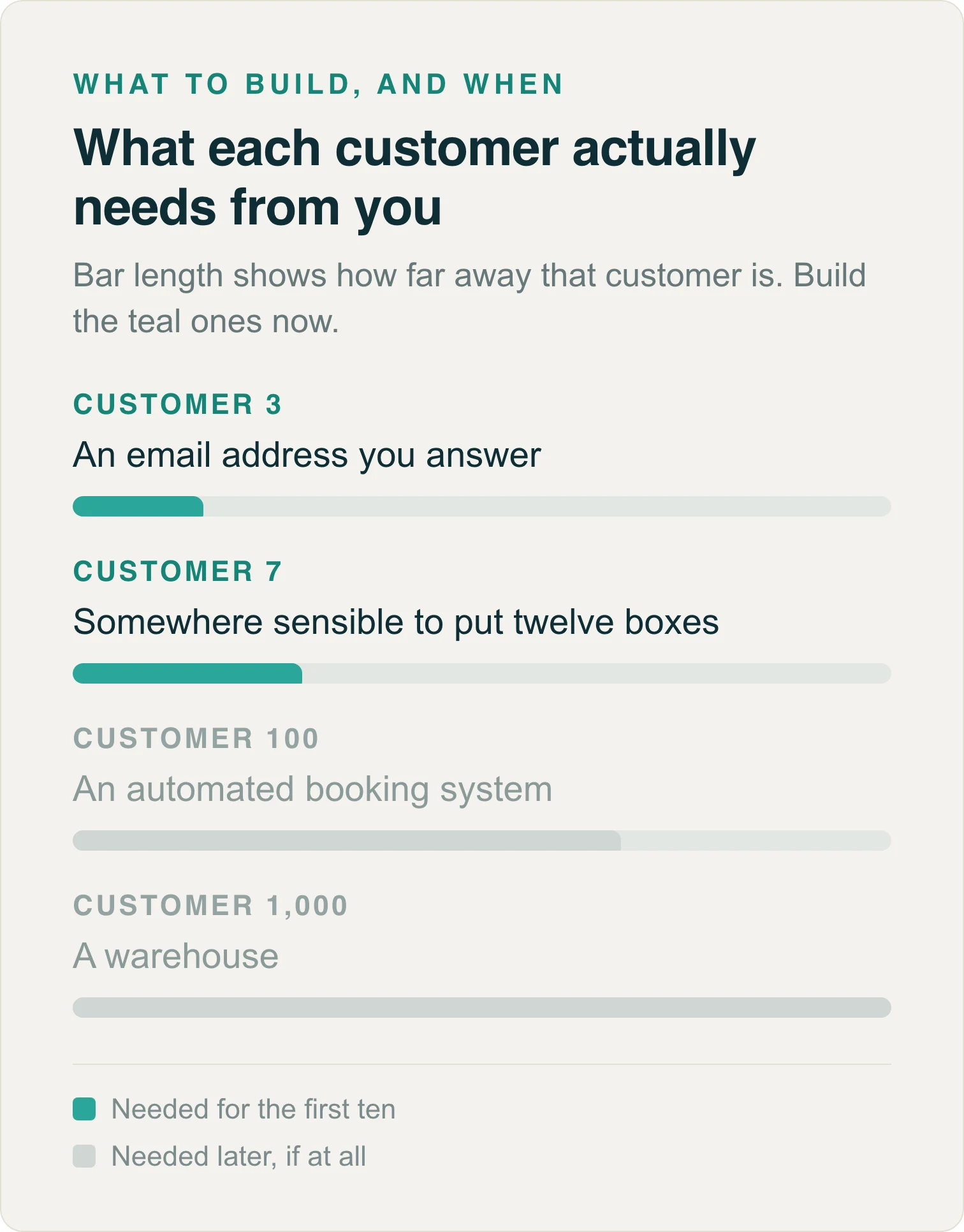
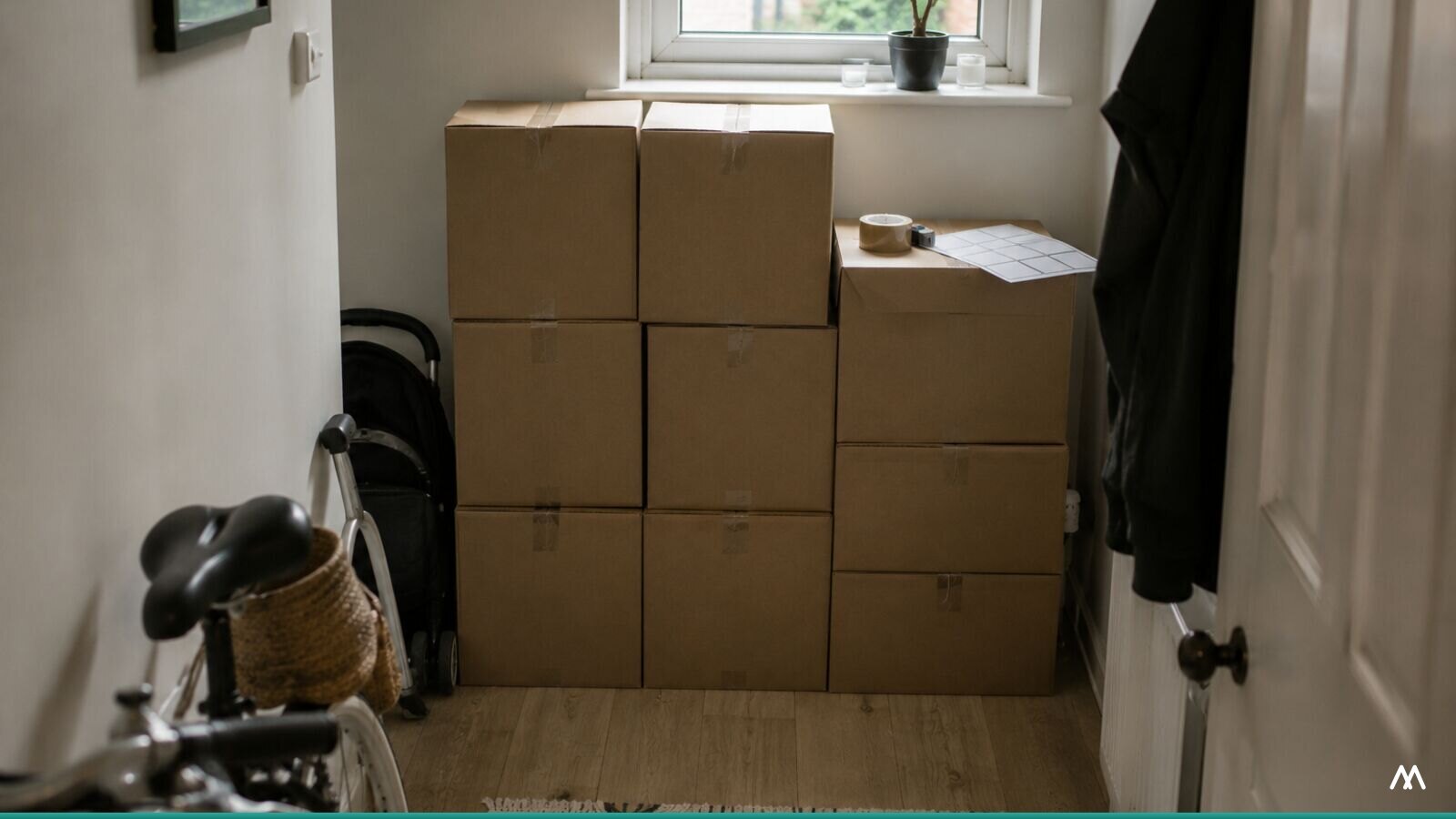
There is a time for building the machine. First, establish that anybody wants what comes out of it.
This week, find one customer rather than planning for ten
Ten can still feel abstract. One is useful.
Choose the person most likely to buy what you sell, and make the description narrower than feels comfortable. Then look at the business as they would. Search for it. Open the website on your phone. Try to work out what it does without using anything you know because you built it. Send an enquiry. Try to buy something. Fix whatever makes that unnecessarily hard.
Then find one real person who fits the description and put the business in front of them. Not 10,000 impressions. One person. If they do not buy, find out what stopped them. The price might be wrong. The offer might be unclear. They might not need it. All three answers are useful. Then do it again.

There is nothing glamorous about this stage. It is repetitive and occasionally uncomfortable. It is also where assumptions start turning into facts, and where how to get your first ten customers stops being a search term and becomes a Tuesday afternoon.
Which brings us back to the founder checking their phone. Perhaps the answer is not another afternoon changing the website. Perhaps it is closing the laptop, finding the first person who ought to want this thing, and asking them.
Who is customer number one?