
The short answer. A project that is nearly finished can still be the wrong thing to finish. Drop the phrase and ask what remains uncertain, what the next month buys, and whether you would choose it if it landed on your desk today.
“Nearly finished” can become a way of protecting yesterday's decision. The harder question is whether the next month still deserves to happen.
At the Monday meeting, the new customer portal is nearly finished again.
The booking screen works. The difficult integration is less difficult than it was. There is a reassuring list of completed tasks and a slightly less reassuring explanation of why customers cannot use it yet.
Imagine this happening in a small service business. The owner has backed the project, the team has worked hard and a supplier has been trying to turn a moving brief into something usable. Nobody is pretending nothing has gone wrong. Everybody can explain why stopping now would be wasteful.
The question nobody quite answers is whether continuing is still worthwhile.
Nearly finished is a description of the past
A project can be close to the end of its task list and far from producing something useful.
The visible work may be done while the remaining work contains the uncertainty: getting systems to cooperate, making exceptions safe, moving real customers across or finding somebody willing to own the thing after launch.
That makes “how much have we completed?” an incomplete question. It tells you something about effort already spent. It may tell you very little about the cost, risk or value of what remains.
There is a familiar psychological pull here. Having worked for something can make giving it up harder, even when a better option is available. In a 2021 experiment, David Ronayne, Daniel Sgroi and Anthony Tuckwell found that some participants retained a lottery they had earned through effort rather than switch to a superior lottery. That controlled choice is a long way from a business project, but it demonstrates why prior effort deserves scrutiny as a reason to continue.
In the meeting, nobody mentions a lottery. They mention the work the team has put in. They are right to value it. The difficulty begins when respect for that work becomes a commitment to spend more.
The next decision has its own price
Imagine taking the portal project as it exists today and putting it on the table without its history of promises.
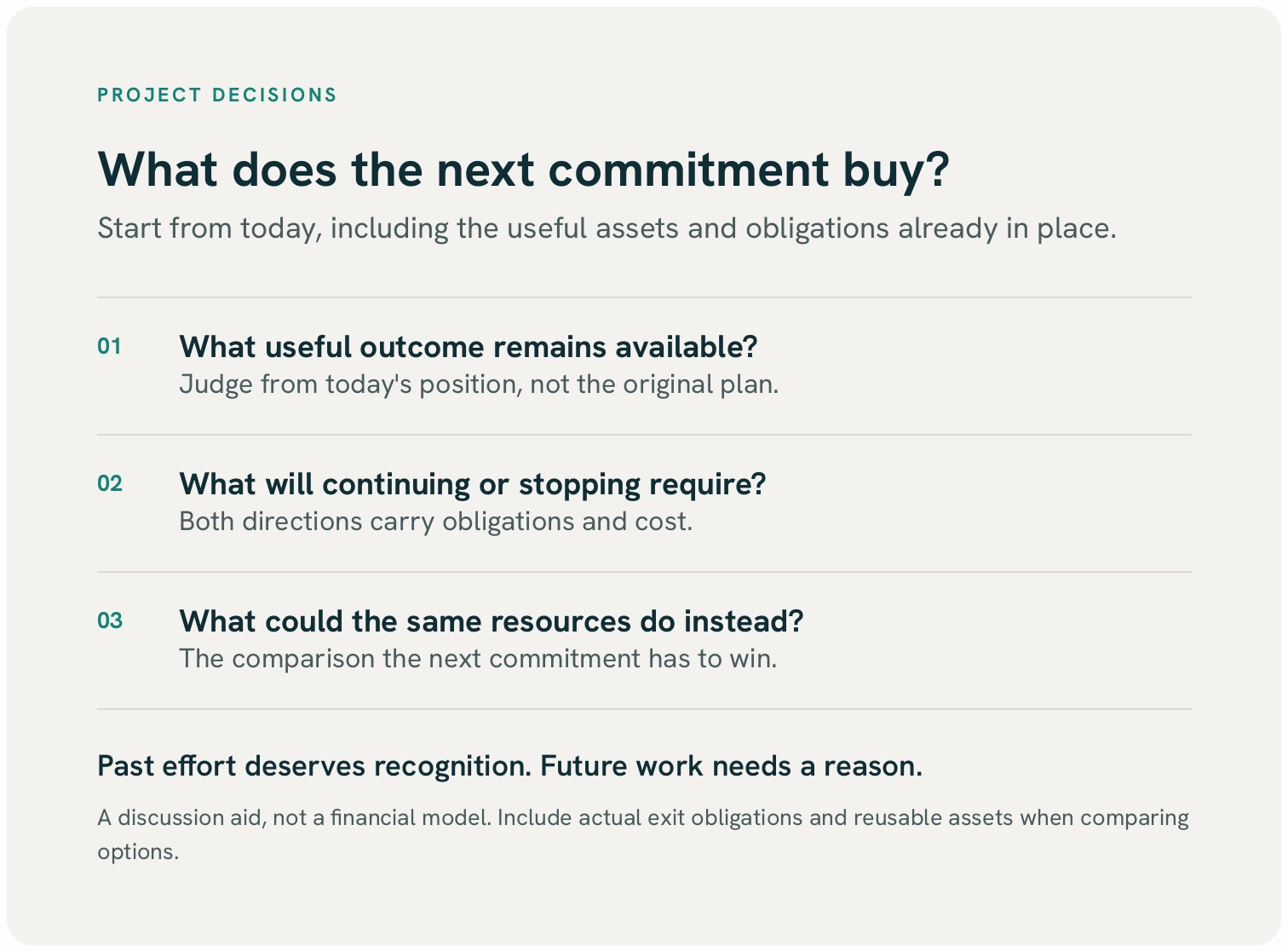
The code, knowledge and usable components remain. So do the unresolved problems, contractual commitments and any obligations to customers. What changes is the question: what is the best use of the next block of time and money?
HM Treasury’s 2026 Green Book says that costs already incurred and impossible to change should not determine what happens next. It also says resources already paid for can still have alternative uses that matter. That is public-sector appraisal guidance, not a rulebook for every company, but the distinction is valuable.
Yesterday’s expenditure cannot be unspent. Today’s useful asset can still be used, adapted or, in some circumstances, sold. Those are different things.
For the portal, the realistic options might include finishing the original scope, releasing a smaller useful function, replacing the troublesome component or closing the work responsibly. Each needs an honest account of what happens from here.
The comparison should include what the business gives up while continuing. A developer, an operations manager or an owner’s attention cannot be fully occupied by this project and fully available elsewhere. Another worthwhile improvement may never have reached the agenda because the portal already occupies the space.
Stopping is work too
A fashionable enthusiasm for quitting can be just as careless as an inability to stop.
Closing the portal might require a contract settlement, a safe home for data, a replacement for something already in use and a proper explanation to people expecting the service. Pausing may mean losing a supplier slot or making a later restart harder. Those are prospective consequences, not sunk costs to wave away.
There may also be good reasons to persist. A difficult integration could now have a credible solution. The users may still need the service urgently. The team may have learned enough to reduce uncertainty substantially. The alternative may be worse.
An overdue project is not automatically an irrational project.
Research on escalation of commitment supports a more complicated picture than stubborn people refusing to admit defeat. A 2012 meta-analysis by Dustin Sleesman and colleagues examined multiple psychological, social and project-related influences. A diagnosis based entirely on the owner’s personality misses much of the setting in which decisions are made.
That matters in the meeting. If the only socially acceptable outcomes are heroic persistence or humiliating failure, the conversation is already distorted. People need a way to change the work without pretending the original decision was foolish or the effort worthless.
The task is to make the next choice better, not to stage a trial of the last one.
Ask what another month would teach you
When the future is uncertain, a bounded next step can be more useful than a fresh promise to finish everything.
For the hypothetical portal, that might mean testing the difficult integration against a realistic set of cases, or letting a small group of consenting users try one safe, limited function. The work should answer a question that could actually change the decision.
Before starting, name that question. What evidence would justify continuing? What result would suggest a smaller scope? What would make the proposed route unacceptable?
Also decide who will interpret the result and when. Otherwise a failed test can become another reason the test was not quite fair, while a promising demonstration becomes a claim that the whole service is ready.
A useful test needs to be proportionate to the consequences. A prototype is not proof of reliability. A cheerful response from an interested customer is not the same as a willingness to use or pay for the finished service. A technical success does not settle whether the business can operate it.
The point of the next month should be clearer than “move it forward”. Movement is easy to report. Reduced uncertainty is harder to fake.
Make room for an answer that disappoints you
The person closest to a project often knows things an outside reviewer does not. That knowledge should be heard. So should a challenge from someone who is not defending the original promise.
The reviewer does not need to arrive with a verdict. They can ask what changed, which assumptions remain untested and whether the alternatives have received the same scrutiny as the preferred route.
The language matters. “Why have you not finished?” tends to produce a defence. “What would you recommend from this position?” gives somebody a chance to use what they have learned.
For the owner, that may require saying explicitly that a recommendation to reduce scope or stop will be considered on its merits. If the next supplier proposal must make the past look successful, the business is asking for reassurance while pretending to ask for advice.
Recognise useful work accurately. Preserve the parts that have value. Be honest about the parts that do not. People can accept a difficult decision more readily when their effort is visible and the reasoning is intelligible, although no phrasing makes every disappointment easy.
A project does not need to reach its original finish line for its learning to matter. It does need a clear account of what that learning changes.
Monday needs a different question
Return to the meeting. The portal may still be worth finishing. It may be worth finishing differently. It may have reached the point where the business should stop asking it to justify another month.
A fresh decision could produce any of those answers.
What it should not produce is another automatic extension based entirely on how much has already happened. The past deserves an explanation. It does not get an unlimited claim on the future.
Before the next update, imagine removing “nearly finished” from the vocabulary. Ask instead what remains uncertain, what useful outcome is still available and what the next commitment buys.
Then give the people doing the work enough room to answer honestly.
If this project arrived on your desk today, exactly as it stands, would you choose its next month?