
The short answer. Most lost work is not won by a rival. It is abandoned, often by a buyer who wanted to say yes and lost their nerve. When a buyer goes quiet, find out whether they chose someone else or chose nothing, then look for the same parked decisions in your own business.
Most of the work a business loses is not won by anybody. It is abandoned. And the buyers who abandon it are mostly not the ones who preferred what they already had.
The quote went out on a Tuesday. The meeting had gone well enough that somebody used the word “obviously”. Two questions came back, both sensible, both answered the same afternoon.
Then nothing for a fortnight. Then a short, friendly message: they have decided to park it for now, and they will come back to it later in the year.
There is a strong temptation to work out who won. Usually nobody did. The budget was not spent. The problem the buyer described is still there, being tolerated. The competitor that beat you does not exist.
The largest category of lost work is nothing at all
This is measurable, and the measurement is uncomfortable. In The JOLT Effect, published in 2022, Matthew Dixon and Ted McKenna analysed more than 2.5 million recorded sales conversations. Between 40 and 60 per cent of qualified opportunities ended in no decision rather than in a loss to a competitor.
A qualified opportunity is not a cold list. These were buyers who had a problem, took meetings, involved colleagues and asked for a price. They were not persuaded by somebody else. They were not persuaded to do anything.
The dataset comes from sales recording technology, so it is weighted towards larger business to business selling with long cycles and several decision makers. A two person design studio quoting for a website is not the same setting. The range is a shape rather than a law, and the shape is the point: the thing most often on the other side of a lost deal is an empty chair.
Which means most competitive analysis is aimed at the wrong target. A business will spend a morning studying three rivals and no time at all on the option that beats all four of them.
The strongest competitor almost every business faces is next year with nothing changed in it. That competitor has no website, undercuts everybody, requires no meetings, and wins more often than all the named ones combined.
The reason they did nothing is not the reason you assume
The usual explanation is inertia. People like what they have. Change is effortful, the current arrangement works well enough, and nobody was ever sacked for leaving things alone.
That instinct has serious support behind it. Samuelson and Zeckhauser established status quo bias in 1988, across a series of decision experiments in which people disproportionately stuck with whatever was presented as the existing option.
Their field data was the more telling half. Looking at how university staff chose health and retirement plans, they found long standing members sitting in options that new joiners, reading the same list without a previous choice to defend, were steadily rejecting in favour of better terms. Nobody had decided to hold a worse plan. They had simply never decided anything.
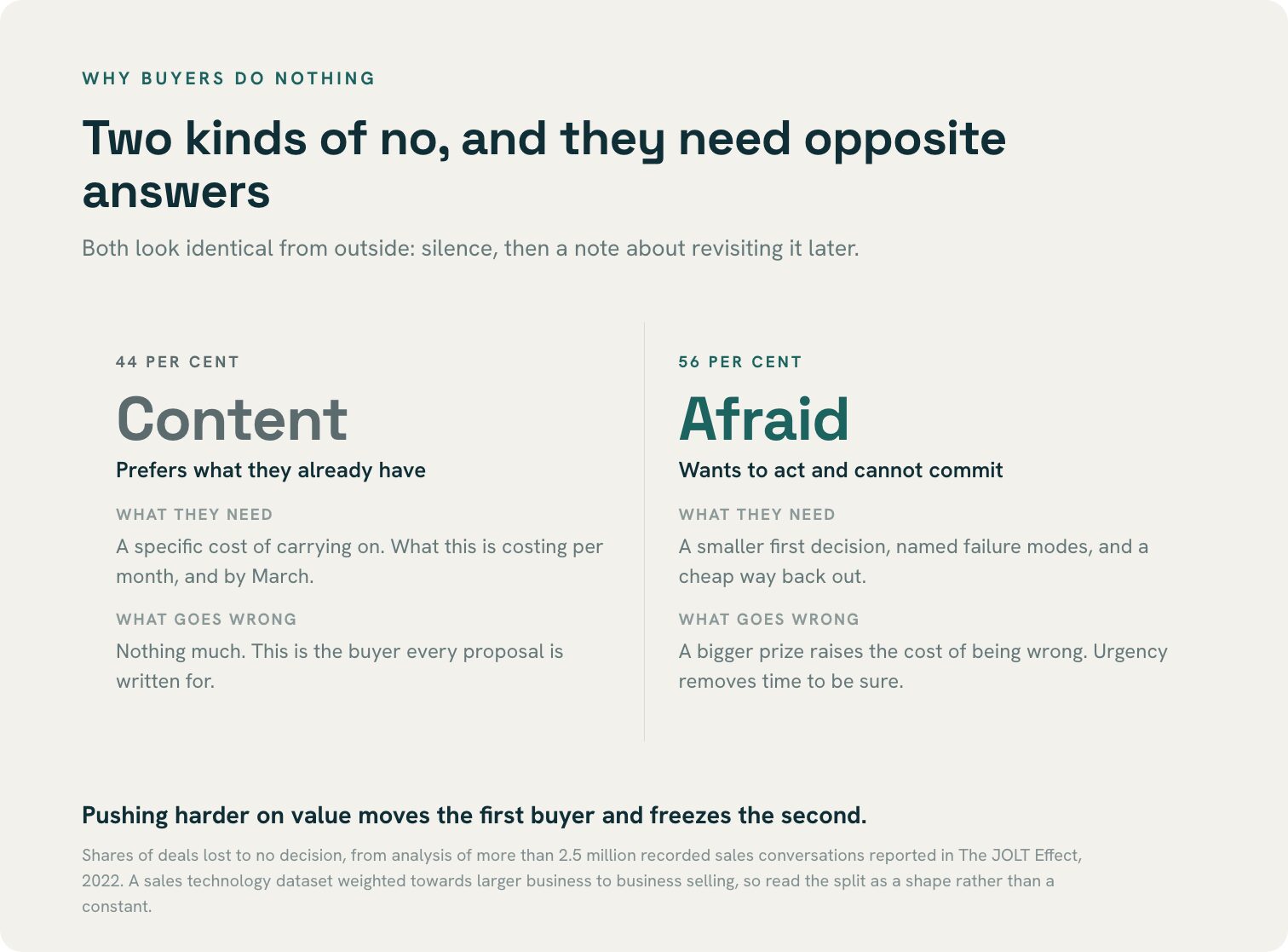
But when Dixon and McKenna separated the no decision outcomes by cause, preference for the status quo was the minority explanation. It accounted for 44 per cent. The larger share, 56 per cent, came from something different: buyers who wanted to change and could not bring themselves to commit.
Those two look identical from the outside. Both produce silence, a diary note and a polite message about revisiting it later. They are opposites underneath.
One buyer is content. The other is afraid.
The two require opposite responses, and one of them is the response everybody gives
A buyer who genuinely prefers what they have needs a reason to move. The cost of carrying on, made specific. What this is costing per month. What it will cost by March. That is the case for change, and almost every proposal is built to deliver it.
Apply that to the second buyer and it goes backwards.
Somebody who already wants to act and cannot commit is not short of reasons. They are worried about being wrong in public. Making the prize larger raises the cost of getting it wrong. Adding urgency shortens the time available to be certain. Every lever that works on complacency works in reverse on fear, which is why the most enthusiastic buyer in the room sometimes turns out to be the one who goes quiet.
It is worth saying plainly what the fear is usually about. It is rarely the money. It is the meeting in four months where somebody asks how this is going.
Everything you built is worth less to them than it is to you
There is a second gap sitting underneath all of this, and it is arithmetical.
In Eager Sellers and Stony Buyers, published in the Harvard Business Review in 2006, John Gourville set out the mismatch. People who build something overvalue its advantages by roughly a factor of three. People who already own something overvalue what they have by roughly a factor of three, which is the endowment effect doing its ordinary work. The two errors multiply. A seller and a buyer looking at the same switch can be about nine times apart on what it is worth.
Those factors are estimates assembled from behavioural research rather than a measurement taken from any particular market. Read the nine as an order of magnitude, not a number to put in a spreadsheet.
Even read loosely, it explains a familiar experience. An improvement that seems obviously worth having produces polite interest and no movement. Nobody is being difficult. The improvement needs to be several times better than the thing it replaces before it feels like an improvement at all, and the person who built it is the least able to judge whether it clears that bar.
Which makes a proposal a risk document
Most proposals are written as arguments for value. Given the above, a good proportion of the reader’s attention is going somewhere else entirely, to three questions that usually appear nowhere in the document.
Will this work here, in this business, with these people, rather than in the general case. What happens if it does not. And who will be standing next to the decision when somebody asks about it later.
A few things follow, and none of them is a closing technique.
Make the first decision smaller than the project. Not a discount and not a trial that quietly commits them to everything. A genuinely bounded first stage with its own end, its own output and a real decision point after it. This is the single most useful thing available, because it changes what the buyer is being asked to be certain about.
Name the ways it could go wrong yourself. This reads as a poor idea and works surprisingly well. A supplier who has already said which part is most likely to slip, and what happens then, is easier to defend internally than one who presented an unblemished plan. Nobody believes the unblemished plan anyway.
Write the case they will have to make without you. Decisions of any size get discussed in rooms the supplier is not in, by a person repeating an argument from memory. Most proposals are unusable for this. A short, plain summary that somebody can repeat accurately is worth more than forty polished pages, and it is usually the part nobody writes.
Make stopping cheap, and say so out loud. Where the reversal is genuinely inexpensive, that fact is worth more than another benefit. Where it is not, saying so is worth more than pretending otherwise, because the buyer has already guessed.
There is an honest limit here. Some buyers should not proceed. The point is not to convert everybody who hesitates, and a business that treats every hesitation as an obstacle to be handled becomes tiring to buy from. The point is that a large share of the no decisions were people who wanted to say yes, and lost nerve somewhere nobody watched.
The awkward part, which is about you
None of this is only a selling problem, and treating it as one misses the useful half.
Every business has its own list of parked decisions. The supplier everybody agrees is not good enough. The pricing that has not moved in three years. The hire that was agreed in principle in February. None of these is unknown, and none of them is waiting for information.
They are waiting for somebody to be willing to be wrong in front of colleagues. Which is precisely the thing the buyer who went quiet could not do either.
It is easier to see it from this side. The business that keeps losing work to nobody and the business that keeps parking its own decisions are usually the same business, and it is a great deal more comfortable to diagnose the first.
The next time a buyer goes quiet, will you assume they chose somebody else, or find out whether they chose nothing at all?