
The short answer. Most searches now end without a visit, so most people who look you up read a summary of your business assembled by a search engine or an AI assistant, not your website. Make the plain facts about what you do, for whom and where match everywhere they appear, and check what the assistants say about you.
Search increasingly answers instead of referring. That moves the important description of a business off its own website and into a sentence the owner will never see and cannot edit.
Somebody heard your name this week. Perhaps in a meeting, perhaps from a friend, perhaps in a list of three suppliers worth a look.
They typed it in. They read a paragraph. They formed a view.
They did not visit your website, and you have no record that any of this happened. Your analytics show the same quiet Tuesday they always show.
Most searches no longer end in a visit
The scale of this is now reasonably well documented, if you accept the limits of the measurement.
SparkToro, working from Similarweb clickstream data, found that 68.01 per cent of Google searches in the United States ended without a click during the first four months of 2026. The share of searches producing at least one click fell from roughly 39.55 per cent in 2024 to roughly 31.99 per cent in 2026.
Those figures come from a panel rather than from Google, cover the United States, assume a two thirds split towards mobile, and exclude searches made inside Google’s own mobile app. They are an estimate. They are also the best public estimate available, and the direction has not been seriously disputed by anybody.
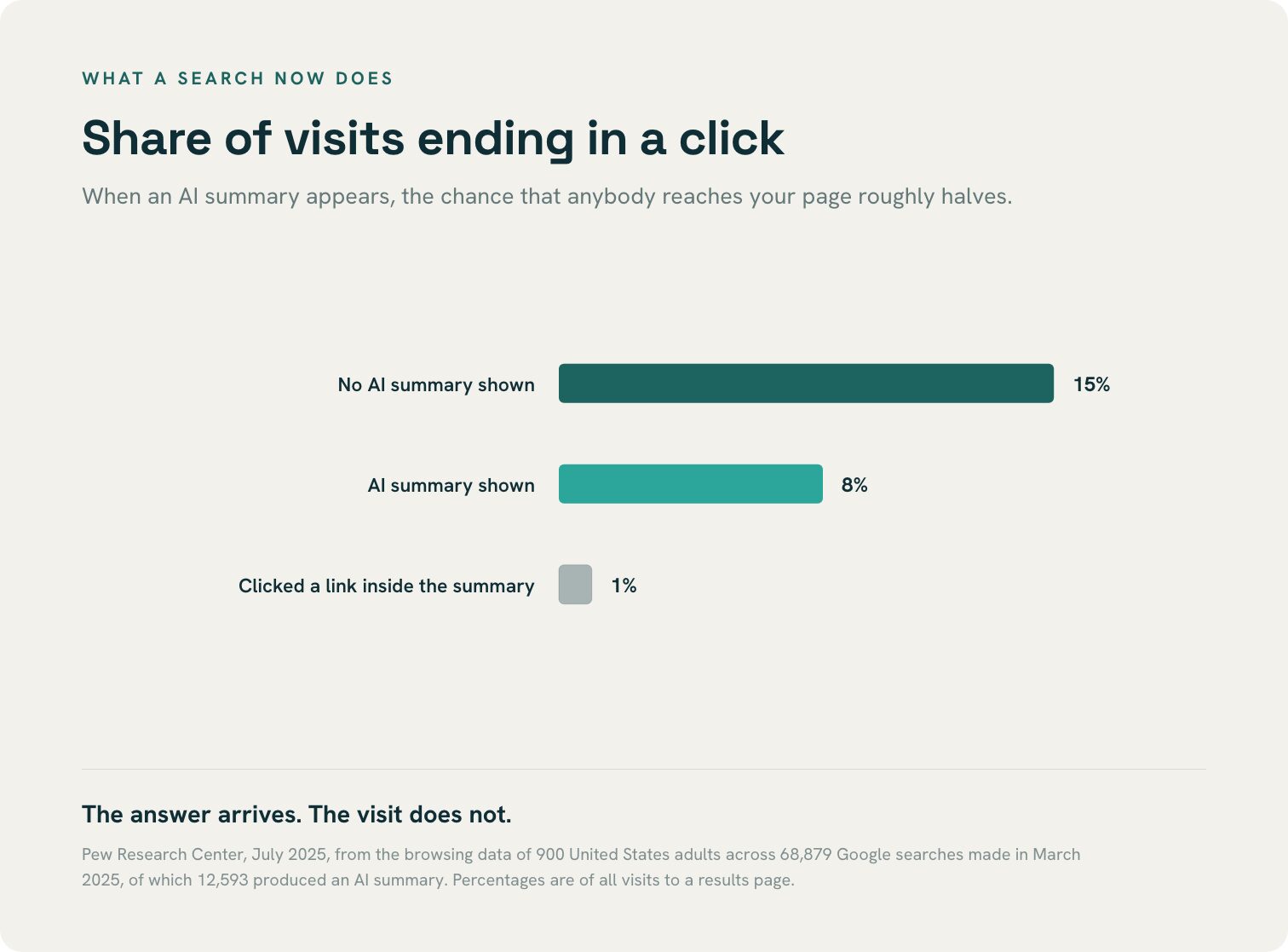
On the specific effect of AI summaries, the cleanest evidence is from the Pew Research Center, which in July 2025 analysed the actual browsing data of 900 American adults across 68,879 Google searches made in March 2025. Where an AI summary appeared, users clicked a traditional search result on 8 per cent of visits. Where no summary appeared, they clicked on 15 per cent.
Clicks on the links inside the summary accounted for 1 per cent of visits. And users abandoned the session entirely on 26 per cent of pages carrying a summary, against 16 per cent without one.
About one search in five produced a summary at the time. That proportion has not gone down since.
The traffic is the least interesting part
The obvious reading of those numbers is that a website will get fewer visitors. That is true, and the smaller half of the story, particularly for a business that never had many visitors.
The larger change is one of authorship.
When search referred people, a business had a clear position: the description of it lived on a page it controlled, and the job was to get people to that page. The words were yours. You could change them on a Tuesday afternoon.
When search answers instead, the description that matters is assembled somewhere else. It is written by a system that has read your website, your directory entries, your reviews, your filings at Companies House, a comparison page somebody built to sell something else, and whatever was said about you on a forum in 2023. It weighs those sources by rules you do not know. It produces a sentence you will never read, for a person you will never hear from.
That sentence is now doing the job your homepage used to do. It is also, for a growing share of enquiries, the only thing anybody reads before deciding whether you are worth a message.
Small businesses are more exposed to this, not less
There is an assumption that this is a problem for publishers and large brands. The opposite is closer to true, for a reason that has nothing to do with fairness.
A large company is described from a thick corpus. Hundreds of pages mention it. Errors get averaged out. One stale listing among four hundred sources changes nothing.
A small business is described from a handful of sources, and sometimes from three. In that situation a single wrong fact does not get outvoted. A company name that appears in two forms, an address from a previous office, a service you stopped offering in 2024, a review left by somebody who confused you with another firm: each of these carries weight that would be trivial for a larger organisation and is decisive for a small one.
The thinner the record, the louder each item in it.
What actually helps is duller than it sounds
There is an industry forming around this already, and a certain amount of it is the previous industry with different vocabulary. The useful responses are mostly unglamorous.
Make the plain facts consistent everywhere they appear. What the business is called, what it does, who it does it for, where it operates, how to reach it. Not the positioning, the facts. Where these disagree across your site, your listings and your filings, something has to choose between them, and it will not ask you.
Write down the things you assume are obvious. Much of what a business knows about itself appears nowhere in writing, because everybody involved already knows it. A machine cannot infer what is only implied. If the page says you deliver excellence and does not say you install commercial kitchens in the north west, the first is unusable and the second is missing.
Be described by somebody other than yourself. Your own website is one source, and the one with an obvious interest. A business that is mentioned nowhere else is a business with a very short file, which is the condition that makes everything above go wrong.
Go and read what is currently being said. Ask the assistants what your business does. Ask them whether it is any good and what it costs. This takes ten minutes, and it is the only way to hear the pitch a stranger is being given on your behalf. Most owners have never heard it, and a meaningful number find something wrong in the first attempt.
There is a thread worth noticing here. Writing clearly for a person and writing usefully for a machine have converged almost completely. The homepage written to sound impressive, full of transformation and partnership and no nouns, is now a bad source of information as well as a bad read. The page that says what you do, for whom, where, and roughly what it costs, is a good one for both.
That is a strange outcome. The response to a technology change turns out to be writing plainly, which was available all along.
The page you paid for is not the page being read
None of this means a website has stopped mattering. It means its job has changed.
It used to be the destination, and it was judged on whether people arrived and what they did when they got there. It is now, increasingly, a source. It is read by things that summarise it for people who will never see it, and it is judged on whether it is clear, consistent and complete enough to be quoted accurately by something with no interest in flattering you.
Which is a demotion, and also a relief. A source does not need to be beautiful. It needs to be right.
Have you ever read the description of your business that a stranger is actually given?